Paqtra vs PacketWolf
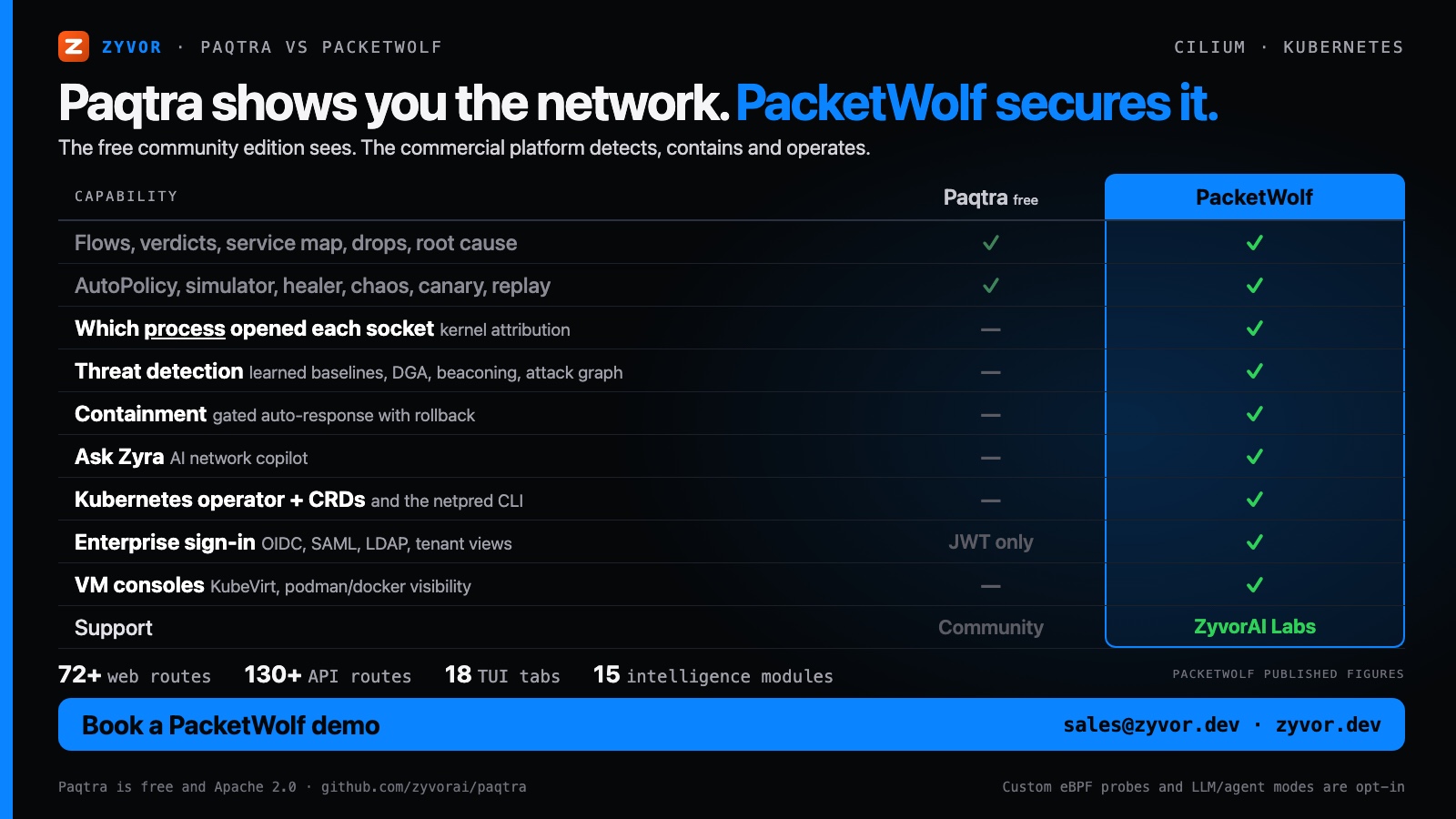
Paqtra is the free, Apache-2.0 community edition. PacketWolf is the commercial platform built on the same Cilium-native foundation. Paqtra shows you what your Cilium cluster is doing and why. PacketWolf goes further: it attributes traffic to processes, detects threats, contains them, and operates policy for you.
Both target Kubernetes clusters running Cilium 1.14+ with Hubble enabled. Paqtra is read-only toward the datapath by design (see cilium-brotherhood.md). PacketWolf adds custom eBPF probes, an in-cluster operator and enforcement backends.
PacketWolf figures are its own published numbers (Feature Guide), with the capabilities spot-checked against its source tree. Paqtra figures come from this repository.
At a glance
| Paqtra (community) | PacketWolf (commercial) | |
|---|---|---|
| License | Apache 2.0 | Proprietary, commercial license from ZyvorAI Labs |
| Web dashboard | 60+ pages | 72+ routes, desktop-style shell with global search |
| REST API | OpenAPI-documented, 90+ paths | 130+ routes plus live WebSocket streams |
| Terminal UI | 13 tabs | 18 tabs (adds Graph, Kernel, L7, ChaosBPF, Sandbox) |
| CLI | paqtra install / status / TUI | netpred: trace, policy, graph, chaos, canary, kernel, operator, CRDs, explain |
| Datapath access | Read-only Cilium map inventory via bpftool | Read-only map decoding plus opt-in custom eBPF probes |
| Kernel process attribution | No | Yes: socket → process → container → pod |
| Threat detection | Baseline anomaly scoring | ThreatSense detectors, learned baselines, attack graph |
| Containment / enforcement | Policy applied as CiliumNetworkPolicy | Six containment profiles, gated auto-response with rollback |
| Kubernetes operator and CRDs | No | Yes (GitOps-managed network intent) |
| Copilot | No | Ask Zyra, with 58 read-only tools |
| Identity | JWT | JWT plus OIDC, SAML and LDAP, tenant views |
| VMs and non-Kubernetes containers | No | KubeVirt VMs, podman/docker/containerd hosts |
| Support | Community | ZyvorAI Labs |
What both give you
Paqtra is not a demo. These capabilities exist in both products:
- Live Hubble flows with verdict coloring, service map and topology.
- Packet drop analytics and root-cause analysis with one-click CiliumNetworkPolicy fixes.
- AutoPolicy learning, a visual rule builder, a YAML editor and a dry-run policy simulator.
- A network healer, chaos engineering, canary deployments and flow replay.
- Multi-cluster registration and topology.
- Read-only kernel data views: conntrack, policy maps, IP cache, LB maps.
- Web dashboard, REST API and terminal UI.
What PacketWolf adds
1. Kernel intelligence: past pod-to-pod
Paqtra sees flows between pods and identities. PacketWolf sees the process behind every socket.
- Process-to-network attribution. Maps each socket to the process, container and pod that owns it.
- TCP lifecycle tracking. SYN, ESTABLISHED, FIN, RST and TIME_WAIT with per-connection timing, to spot stuck, half-open and churning connections.
- Behavioral fingerprinting. Per-workload profiles of connection patterns, ports and timing, for drift detection against a workload's own history.
- Cross-layer correlation. L3, L4, L7, process and eBPF signals in one incident view.
- Syscall tracing.
connect,bind,accept,sendmsgandexecvethrough kprobes and tracepoints (opt-in, needsCAP_BPF). - God Mode explain.
netpred explain <service>fuses kernel, DNS, network and policy state into one root-cause narrative.
2. A custom eBPF data plane
Paqtra never attaches programs, on purpose. PacketWolf adds opt-in probes for TCP lifecycle, process mapping, DNS path, drops and TCP anomalies, draining into an event bus. Its /ebpf-dataplane view reports which probe phases attached, which failed and which still run in userspace, so an empty panel is never a mystery.
3. Threat detection
- ThreatSense detectors with confidence, a reason chain and a recommended action.
- Learned behavioral baselines using per-workload EWMA and a z-score gate, not fixed thresholds.
- DGA and NXDOMAIN-storm detection, and beaconing detection by inter-arrival periodicity.
- ThreatThread and attack graph. Alerts are correlated into multi-stage attack stories.
- GeoThreat enrichment with ASN, country and reputation, with optional MaxMind and threat-intel feeds.
- ProcessLens and RuntimeGuard. Tetragon exec events tied to the Hubble flows they opened.
4. Policy and Zero Trust, in depth
- Zero-Trust Pilot. A guided observe → simulate → approve ratchet toward default-deny, one reviewed step at a time.
- Policy Insight. Plain-language explanation of any policy and a least-privilege scorecard.
- Blast-radius simulation. Which flows and services a change would affect before it ships.
- Policy drift scanner and KubePosture. Intended versus live posture, and a single segmentation score with default-deny gaps and world-egress findings.
- Guided scope wizard. Pick a VM, pod, namespace or the whole cluster instead of hand-typing selectors.
5. Autonomous response and containment
- Six containment profiles: FullIsolation, InternetLock, ExfiltrationLock, InvestigationMode, LateralMovementLock and timed Maintenance. They are enforced through Cilium, nftables or libvirt backends.
- Detect-to-contain loop. Each high or critical detection is mapped to a profile with a simulated blast radius and a gated confidence.
- Gated auto-response with verification and automatic rollback on failure. It is off until you enable it, and anything not confident or safe queues for approval.
- Namespace and cluster-wide GuardPolicy, reconciled by the operator into a real
CiliumNetworkPolicyorCiliumClusterwideNetworkPolicy. - Forensic pack and incident story. IR evidence with a CEF sample and an attack narrative, ready for responders.
- Durable by design. The
WorkloadContainmentCRD is the source of truth, so containment survives restarts and control-plane loss.
6. Ask Zyra, the network copilot
Ask questions about cluster networking in plain English. In agent mode Zyra investigates with 58 read-only tools in a bounded observe-then-replan loop, routes hard questions to threat, policy, DNS, forensics and containment specialists, and keeps per-conversation memory. Write actions (submit a policy, run a playbook, apply a response) require explicit confirmation. On LLM failure it falls back to a deterministic rule router. LLM and agent modes are off by default.
7. Compliance, cost and prediction
- Compliance Lens maps live posture to SOC 2, PCI-DSS, HIPAA and Zero Trust controls. Paqtra's audits cover CIS, NIST and SOC 2.
- CVE posture. Prioritize the CVEs that are reachable over the wire.
- Cost-aware egress. See where bytes leave and where the spend is.
- Risk trend and forecast. A 14-day ring buffer projects when risk turns critical and likely next targets.
- Network SIEM report, digital twin and network score. An executive report, a snapshot of the network and one trendable health number.
8. Platform and enterprise integration
- Kubernetes operator and CRDs, built on kube-rs with finalizers, status conditions and leader election, for GitOps-managed network intent.
netpredCLI, scriptable end to end.- Enterprise identity: OIDC, SAML and LDAP sign-in, and tenant views. On Paqtra's roadmap, shipping in PacketWolf.
- SIEM export and remote-access audit.
- SASE-adjacent APIs: ingress and egress security overviews, structured egress-gateway management and Hubble-to-policy drafts.
9. Consoles for every kind of workload
- KubeVirt VMs: serial console and VNC in the browser, NIC binding control, and VM network context next to pods.
- In-browser shell into pods and containers.
- Non-Kubernetes containers. A lightweight node agent surfaces podman, docker and containerd containers as first-class workloads.
- Expose and de-expose ports on demand, and block/allow enforcement per workload (nftables for non-Kubernetes containers).
Which one should I use?
| Choose Paqtra when… | Choose PacketWolf when… |
|---|---|
| You run Cilium and want to see flows, drops and policy verdicts | You need to know which process opened a connection |
| You are evaluating, learning or running a lab | You are running production workloads that need detection and containment |
| Apache 2.0 and community support are enough | You need vendor support and a commercial license |
| You apply policy yourself, through Cilium | You want the platform to draft, simulate, enforce and roll back for you |
| One team, one cluster, JWT sign-in | SSO, multiple tenants, audit and SIEM requirements |
| Kubernetes pods only | VMs and standalone containers share the network |
What to expect
Some PacketWolf features are opt-in, and they are documented that way: custom eBPF probes need CAP_BPF, L7 detectors such as DGA stay inert until deep inspection is enabled for a workload (so they never false-alarm on L3/L4-only clusters), and the Zyra LLM and agent modes are off until you configure them. High-impact containments are approval-gated by default.
Talk to us
PacketWolf is licensed by ZyvorAI Labs. For a demo, a trial or pricing, contact sales@zyvor.dev or visit zyvor.dev.
See also: features.md for what Paqtra ships today, and cilium-brotherhood.md for the boundaries Paqtra keeps.