eBPF: the VM network, rewritten inside the kernel
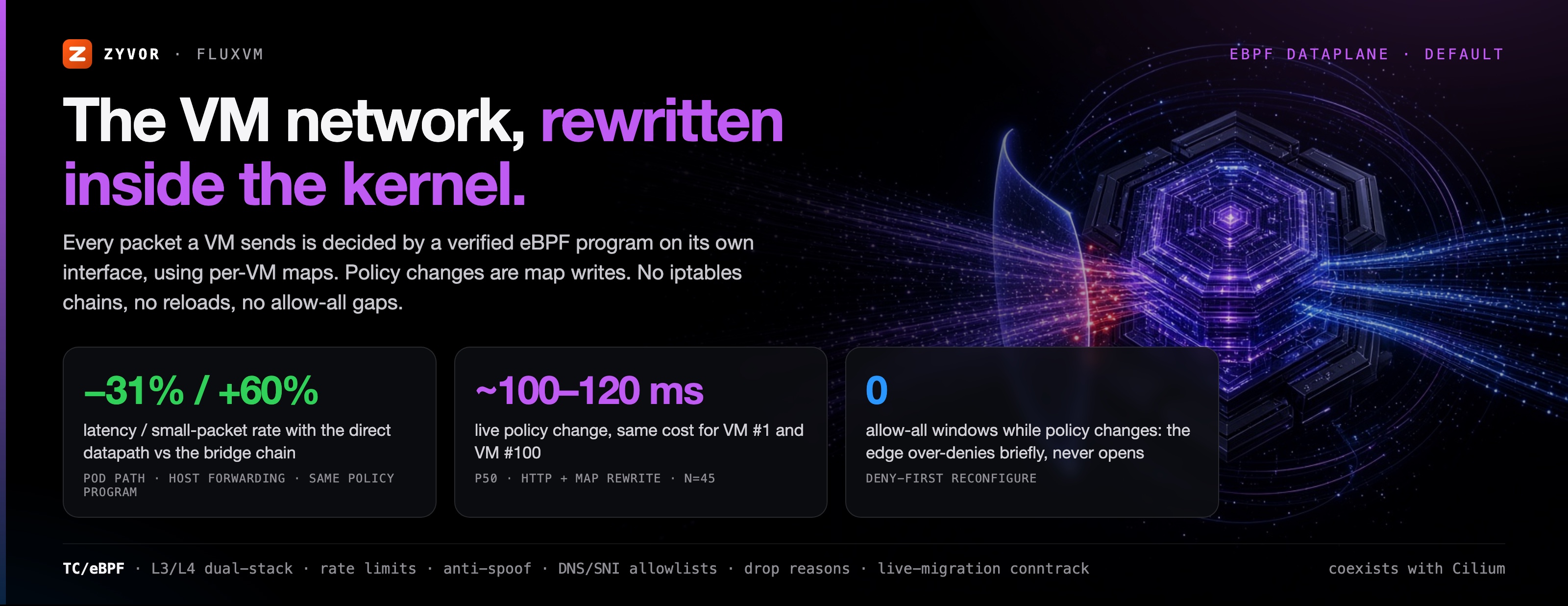
Most virtualization stacks still move VM traffic the way Linux did in 2005: through bridges, veth pairs and long iptables or nftables chains that are rebuilt whenever a rule changes. FluxVM doesn't.
Every VM gets a small, kernel-verified eBPF program on its own network interface. That program reads per-VM maps that hold the VM's identity, allowed networks, ports, rate limits and flow state, and it decides every packet before the packet reaches the rest of the host. Changing policy means updating a map. Nothing is reloaded, nothing detaches, and the edge never fails open.
This is the default. Since FluxVM 0.4 a host whose config doesn't say otherwise runs the native
eBPF dataplane in strict mode (mode = "ebpf", required = true). nftables remains available only as an
explicit compatibility mode. See primary-ebpf.md for upgrade steps.
Why this matters
| You want to... | The old way | With FluxVM eBPF |
|---|---|---|
| Spin up hundreds of VMs | Per-VM chains pile up, and each edit gets slower and riskier | Attach once. A policy change is a map write that costs the same for the first VM and the hundredth |
| Stop a misbehaving VM or agent now | Rebuild the firewall and hope nothing slipped through during the reload | Live deny or rate limit while the program stays attached |
| Prove what a VM talked to | grep logs, conntrack and tcpdump | Per-VM stats, flows and attributed drop reasons over REST |
| Move a VM without dropping its connections | Established TCP sessions break on cutover | Conntrack moves with the VM and is checked against the destination policy |
| Run next to Kubernetes networking | Two owners fighting over iptables | Coexists with Cilium: FluxVM owns the VM edge and never writes Cilium's maps |
The packet path
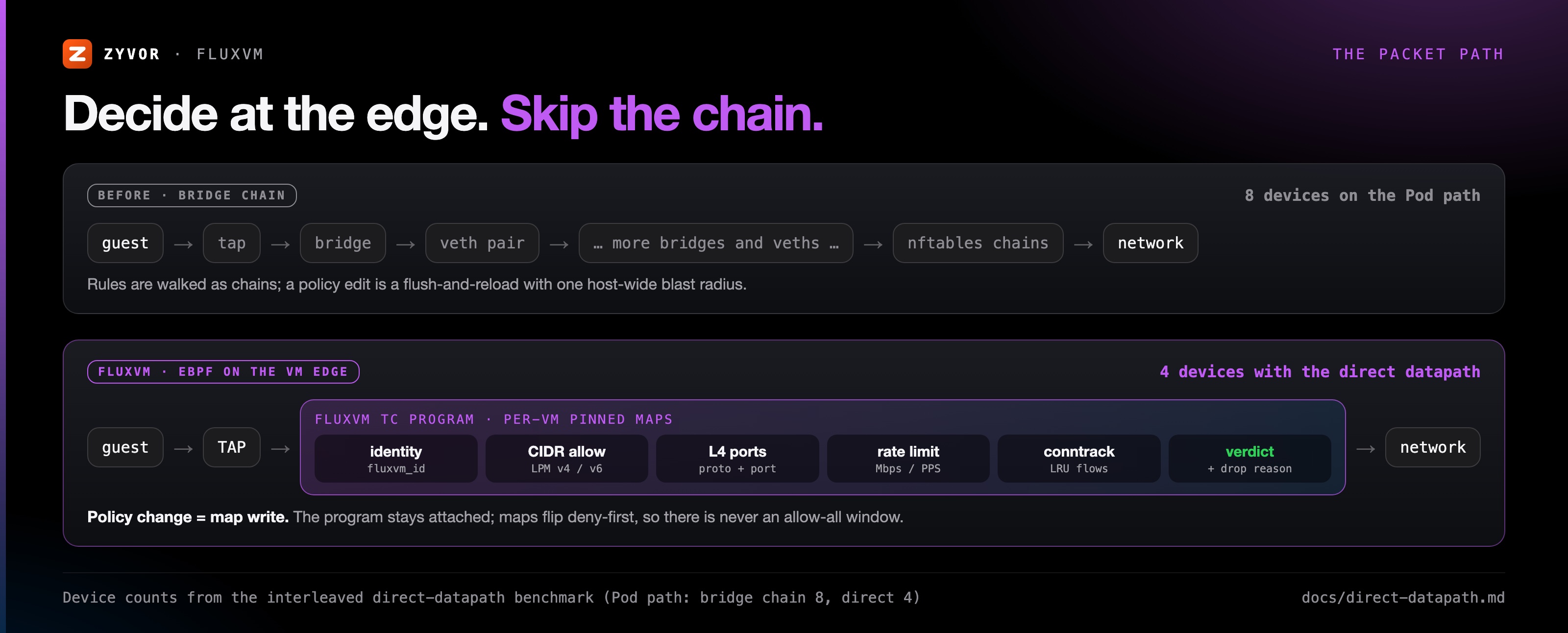
A packet leaving the guest hits FluxVM's TC program on the VM's TAP (or its netns veth). In order, the program:
- Looks up the VM's identity (
fluxvm_id). Bootstrap traffic (ARP, DHCP, NDP, DHCPv6) always passes. - Checks the CIDR allowlist with longest-prefix-match maps, one for IPv4 and one for IPv6.
- Checks L4 rules (protocol and port).
- Enforces rate limits in Mbps and packets per second.
- Tracks the flow in an LRU conntrack map.
- Returns a verdict. A drop is counted and attributed to a reason (
spoof_ip,rate_limit,dns_deny,migration-quiesceand so on) so you can see why.
With the direct datapath, the program also redirects frames straight between the outer device and the guest's TAP, which cuts the Pod path from 8 devices to 4. Cilium keeps every hook it has on its side. See direct-datapath.md.
What's in the program
- Dual-stack L3/L4 policy. IPv4 and IPv6 CIDR allowlists plus protocol/port rules in one program.
- Security groups and Cloud Network Policy. Shared groups and CNP objects compile down to the same per-VM maps (network-groups.md, network-policy.md).
- Rate limits.
max_egress_mbpsandmax_egress_ppsas first-class map entries, with no separate tc/htb plumbing. - The VM edge (used by Kairon). Anti-spoof for source IP and MAC, guest-IP learning from ARP, ND and DHCP, DNS and TLS SNI allowlists, a token-bucket egress limit and host-side ingress limits (vm-edge-contract.md).
- Optional XDP source blocklists on the uplink, dropping before the kernel builds an skb.
- Observability without a capture tax.
GET /v1/vms/{id}/network/stats,/flows,/drops,/learned-ip, Hubble-style flow views (hubble-lite.md) and, when you do need packets, a bounded 1-30 stcpdumpcapture you can download as a pcap. - Cilium coexistence.
mode = "cilium"checks that the Cilium agent is present and then attaches only FluxVM's own pinned programs under/sys/fs/bpf/fluxvm(ebpf-cilium.md).
Measured, not promised
| What | Result | Conditions |
|---|---|---|
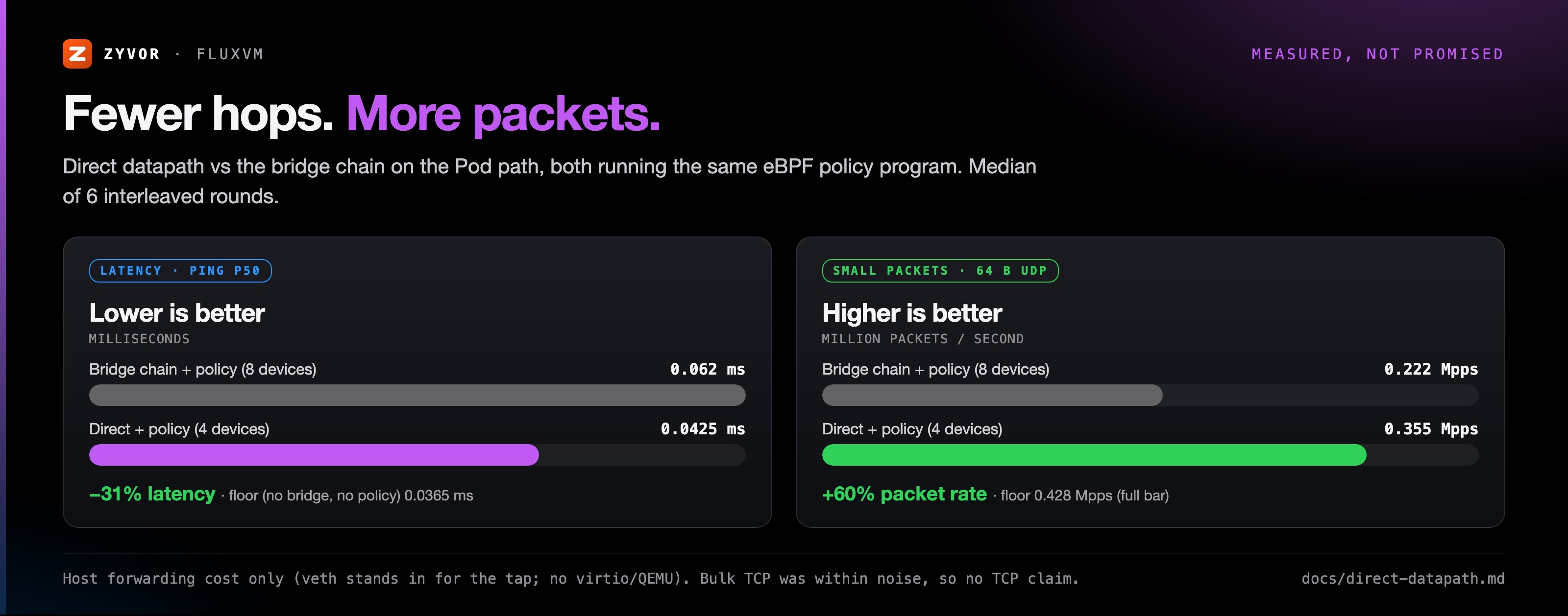
| Direct datapath vs bridge chain, Pod path | -31% latency, +60% 64-byte packet rate | Same policy program on both. Median of 6 interleaved rounds. Host forwarding only (a veth stands in for the TAP, no virtio or QEMU). Bulk TCP was within noise, so no TCP claim (evidence) |
| Live policy change | About 100-120 ms p50 end to end | POST /v1/vms/{id}/network/policy on attached VMs, n=45. Control-plane round trip (HTTP plus map rewrite), not NIC throughput (network-fabric.md) |
| Conntrack restore | One map open, then direct kernel updates | Previously one helper process per entry: 10,000 for a 10,000-entry table (native-conntrack-restore.md) |
| Verifier headroom | fluxvm_tc about 17% of the 1,000,000-instruction limit | Linux 7.0. scripts/test-verifier-budget.sh fails CI above 50%, so a kernel or compiler regression shows up early |
A real guest sees a smaller share of the forwarding gain once virtio and the VMM are included. To measure
your own hardware, run BENCH_INTERLEAVE=1 ./scripts/bench-direct-datapath.sh on a quiet host, or set
BENCH_TARGET_IP to measure a real guest.
Live migration that keeps connections
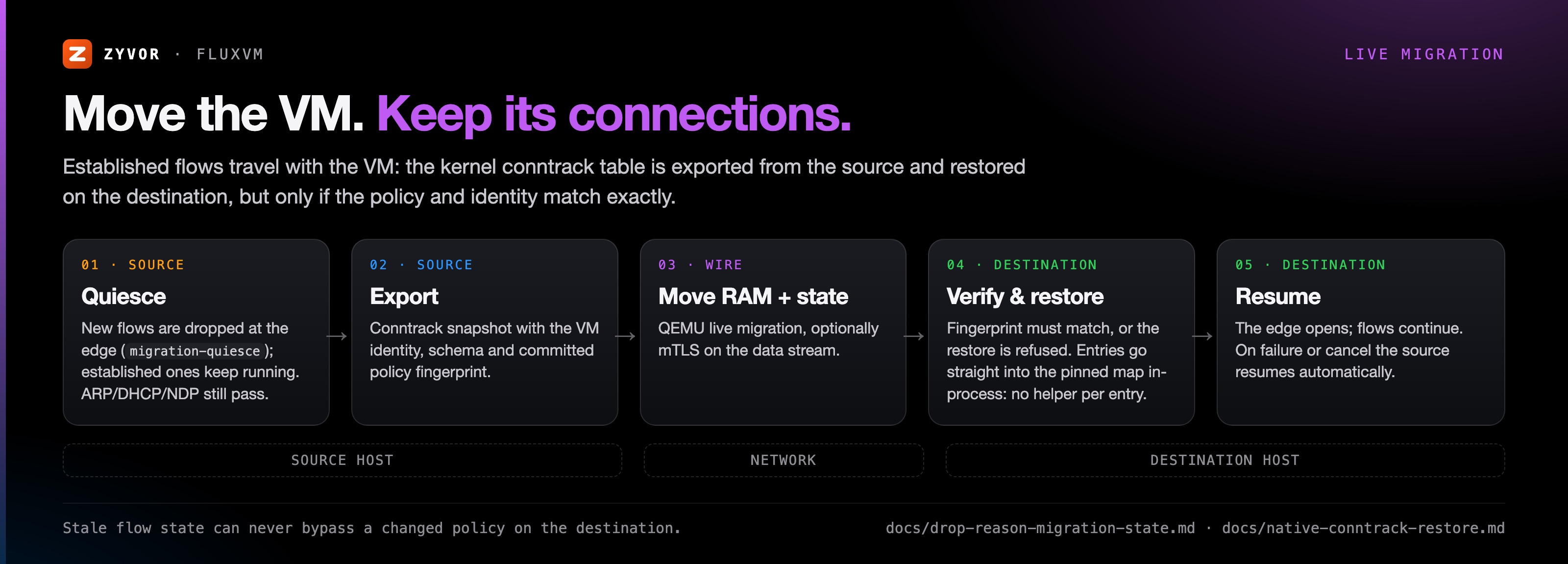
When a VM with an attached dataplane migrates:
- Quiesce (source). New flows are dropped at the edge with reason
migration-quiesce. Bootstrap traffic still passes. - Export (source). The conntrack snapshot carries the VM's identity, the dataplane schema and the committed policy fingerprint. Export refuses an uncommitted policy generation.
- Move RAM and device state with QEMU live migration.
- Verify and restore (destination). The fingerprint, identity and schema must match exactly, or the restore is refused, so stale flow state can never slip past a changed policy. Entries are written straight into the pinned map.
- Resume. If the migration fails or is cancelled, the source resumes automatically.
Details: drop-reason-migration-state.md.
Safety by construction
- The kernel verifies the program before it runs. A program that could loop forever or read out of bounds never loads.
- Changes fail closed. A reconfigure denies everything first, swaps the maps, then publishes the new config. The only window is a brief over-deny, never an allow-all.
- Strict attachment by default. If the program can't attach to a VM's edge, the create or start fails with a readiness hint instead of silently running unprotected.
- Ownership is explicit. FluxVM pins only under
/sys/fs/bpf/fluxvm, detaches only programs whose IDs it recorded, and never touches Cilium's private maps. - Reconcile and repair. A reconcile loop checks schema and policy sync on every attached VM, reloads what drifted and removes pins left by deleted VMs.
Turn it on
On a fresh host the default already selects eBPF. Confirm the host is ready:
./scripts/network-fabric-preflight.sh --require-bpf   # kernel, bpffs, loader tools, BPF permissions
curl -sf http://127.0.0.1:7788/readyz
fluxvm dataplane health                              # must report "ok": true
To also adopt the deny-by-default production policy (the new default keeps default_allow = true):
sudo ./scripts/enable-network-fabric-ga.sh --dry-run   # review the allowlist it will merge
sudo ./scripts/enable-network-fabric-ga.sh --restart
Then set policy per VM:
curl -X POST -H "Authorization: Bearer $TOKEN" http://127.0.0.1:7788/v1/vms/$ID/network/policy \
  -d '{"default_allow": false, "allow_cidrs": ["10.0.0.0/8"], "allow_ports": ["tcp/443"], "max_egress_mbps": 200}'
curl -H "Authorization: Bearer $TOKEN" http://127.0.0.1:7788/v1/vms/$ID/network/drops?limit=20
Hosts that can't load BPF set mode = "legacy" under [sandbox.dataplane]. Upgrading an existing host:
operations.md.
Honest limits
- eBPF owns the VM edge. Host routing, namespace setup, some NAT rules, the virtio transport and the node CNI stay where they are.
- The host needs a kernel with TC eBPF support, bpffs mounted at
/sys/fs/bpf, and BPF permissions for the service (CAP_BPF/CAP_SYS_ADMIN, enoughLimitMEMLOCK). TCX attach needs Linux 6.6+; older kernels use clsact. - The direct datapath needs Linux 5.10+ and a veth primary interface; Multus secondaries and netkit Pods use the bridge chain.
- Published numbers are host-forwarding and control-plane measurements. We make no raw guest throughput claim; measure on your hardware.
FAQ
Do I need Cilium? No. mode = "ebpf" works on any modern Linux host. mode = "cilium" is for nodes
that already run Cilium.
Will it fight my CNI? No. FluxVM attaches only to VM interfaces and its own pins, and refuses XDP in Cilium mode.
What happens if the BPF objects are missing? With the default required = true, VMs with a host
network edge fail to create or start, with a message pointing at the preflight. User-mode NAT and none
networking are unaffected.
Can I go back to nftables? Yes: mode = "legacy". Native-only policy features (the VM edge, pod
policy) are refused there rather than silently downgraded.
Related
network-fabric.md · primary-ebpf.md · direct-datapath.md · ebpf-cilium.md · production-dataplane.md · vm-edge-contract.md · hubble-lite.md