How it works
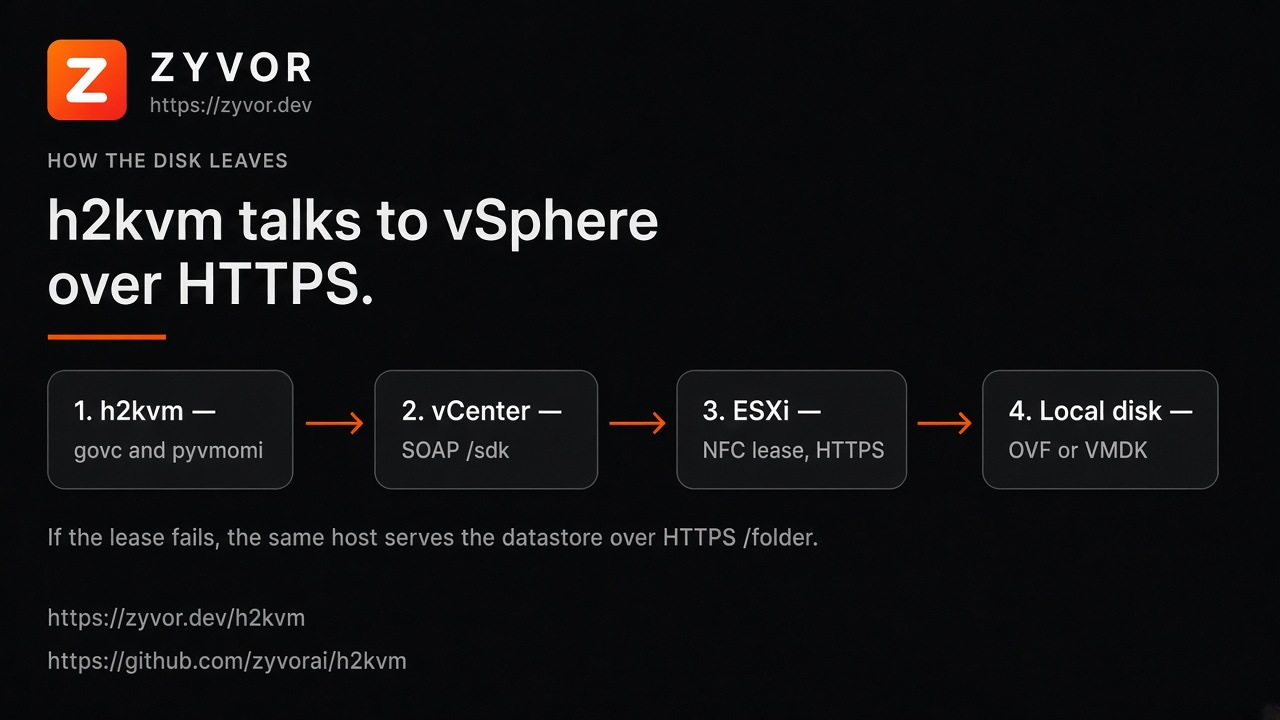
The disk is fixed before it is powered on. h2kvm picks a disk up from wherever the VM lives today, repairs the guest offline, converts it to qcow2, and lands it on Kairon (through Veyron) or a Machina libvirt host. KubeVirt and OpenStack remain as legacy targets.

Where disks come from
There are no subcommands and no --source flag. Pick the mode with --cmd, or cmd: in a YAML config passed with --config.
| Source | How h2kvm picks it up | Entry point | Status |
|---|---|---|---|
| vSphere (govc) | govc export.ovf pulls the OVF and disks over an HTTPS NFC lease. h2kvm packs the OVA itself | --cmd vsphere --vcenter … --vs-vm … | Implemented |
| vSphere (datastore) | GET /folder/… over HTTPS with the vCenter session, resumable | --cmd vsphere --vs-download-only | Implemented |
| vSphere (ovftool) | VMware's ovftool, if you have it installed | --cmd vsphere --ovftool-path … | Implemented, external binary |
| ESXi over SSH | Streams the disk with ssh … cat, with progress | --cmd fetch-and-fix --host … --remote … | Implemented |
| Azure | az CLI: snapshot, SAS URL, ranged HTTPS download | --cmd azure --azure-resource-group … | Implemented |
| Files you already have | Disk on the machine running h2kvm. The qemu-img format comes from the suffix | --cmd local --vmdk FILE (any format), or ova, ovf, vhd, raw, ami | Implemented |
| Folder or manifest | The daemon watches a folder. --manifest runs a declarative 8-stage pipeline | --cmd daemon, --manifest FILE | Implemented |
| Nutanix AHV | Not in this repo. Transiva does the NFS pickup, then you feed the file to --cmd local | — | Via Transiva |
| AWS, Proxmox Backup Server | Library modules only, not reachable from the CLI | — | Not exposed |
| GCP, Xen, VirtualBox, remote Hyper-V | No pickup code. Their disk files (VDI, VHDX) work as local files | — | Not implemented |
What happens to the disk
- Pick up. Extract an OVA or VHD, or download the disk, then discover the disk files.
- Inspect and flatten. VMDKs are inspected first.
--flattenmerges a snapshot chain into one working image. - Repair offline. GuestKit runs
run_migrate_repairon the disk image, then h2kvm injects cloud-init, first-boot, network, user, service and hostname config. - Convert and check.
qemu-img convertto qcow2, thenqemu-img checkon the result. - Deploy, or stop. Hand the qcow2 to one target below, or keep the file.
Where the VM lands
| Target | What h2kvm does | Enable with | Zyvor product on top |
|---|---|---|---|
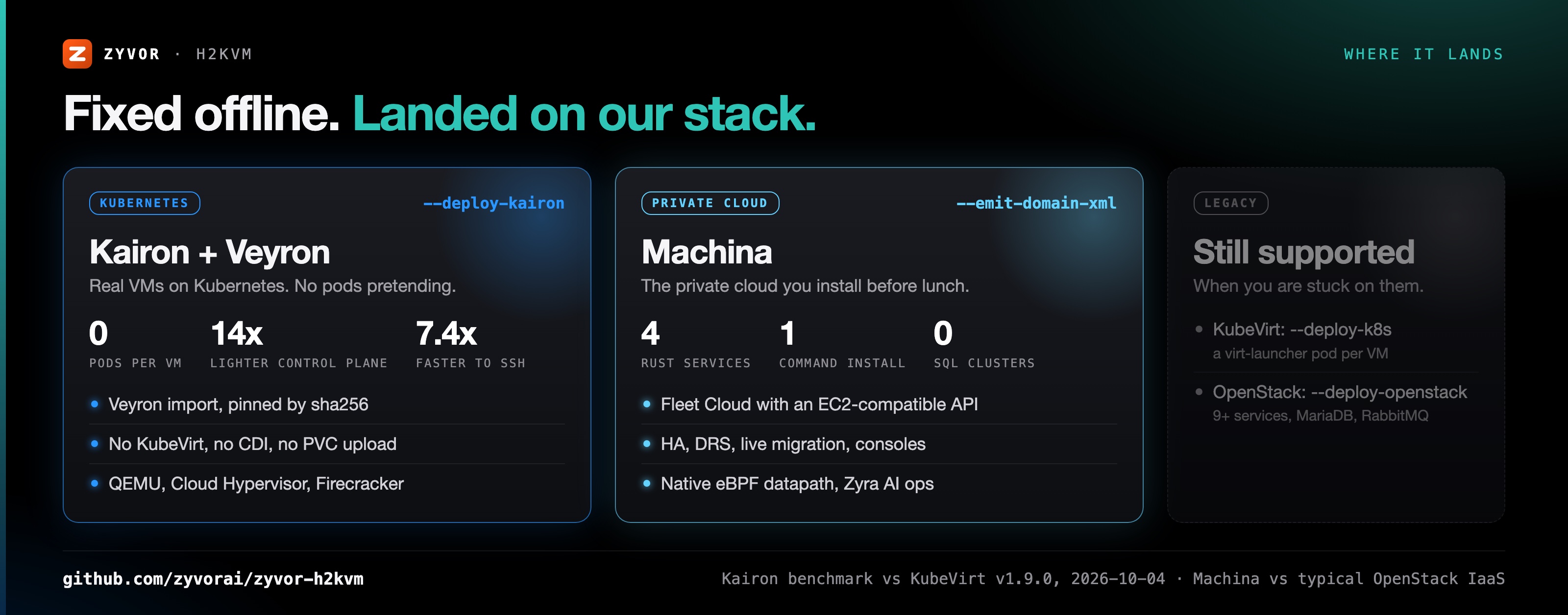
| Kairon on Kubernetes | Asks Veyron (POST /api/v1/imports) to create a Kairon Machine whose image points at the converted disk over HTTP(S), pinned by sha256. kairon-node boots it straight on KVM: no pod, no KubeVirt, no CDI, no PVC upload | --deploy-kairon | Kairon runs the VM; Veyron is the console, API and day-2 ops |
| Machina libvirt host | Emits the domain XML and, with --virsh-define, runs virsh define on the host h2kvm runs on | --emit-domain-xml | Machina is the private cloud for those hosts: Fleet Cloud, HA/DRS, eBPF, Zyra AI |
- One target per run. The CLI and web API reject combining them.
- Kairon is a native integration. h2kvm calls the Veyron API with a key that has the write role (
--kairon-api-keyorVEYRON_API_KEY). - Machina manages the host afterwards. h2kvm defines the VM on a libvirt host; it has no API link to Machina itself.
Why Kairon and Machina instead of KubeVirt and OpenStack
| Ours | Legacy | |
|---|---|---|
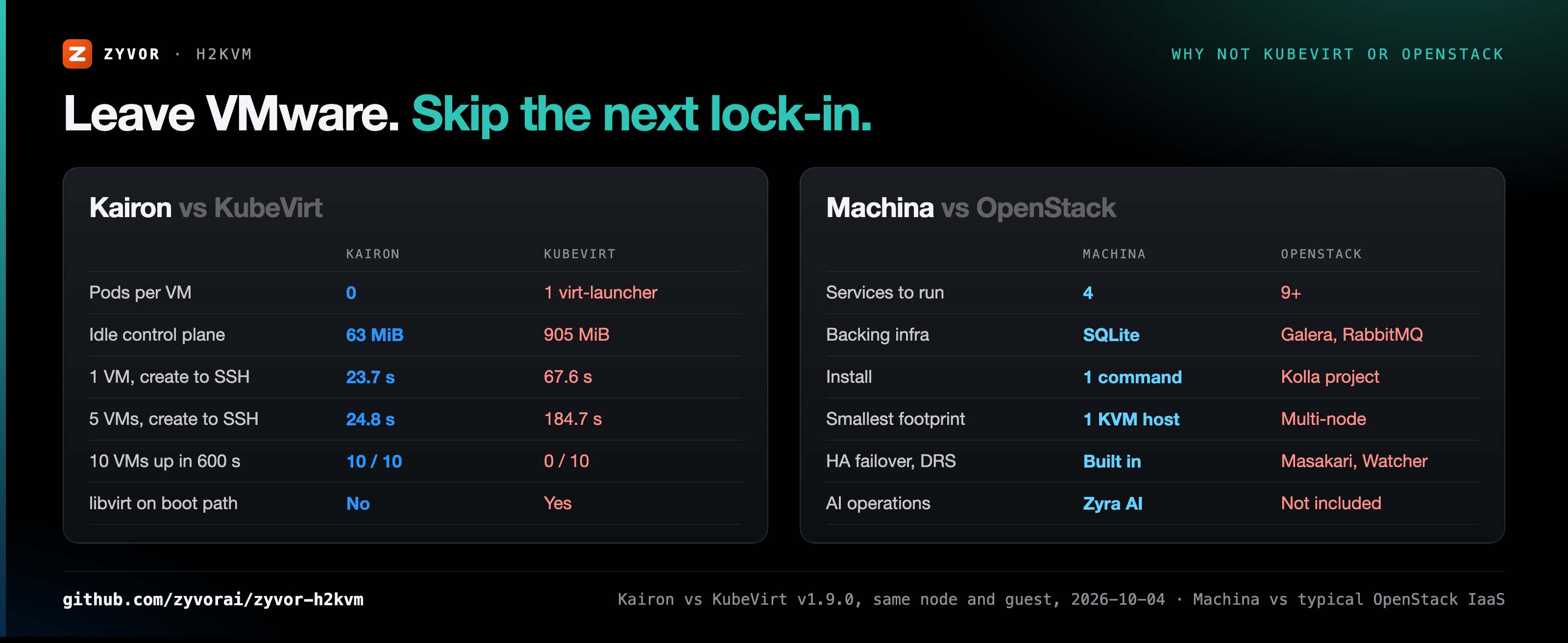
| VMs on Kubernetes | Kairon: 0 pods per VM, 63 MiB idle control plane, 24.8 s to SSH for 5 VMs (p50) | KubeVirt: a virt-launcher pod per VM, 905 MiB, 184.7 s |
| Private cloud | Machina: 4 Rust services, embedded SQLite, ./machinactl deploy on one host | OpenStack: 9+ services, MariaDB/Galera and RabbitMQ, a Kolla-Ansible project |
Kairon numbers: same node and guest, run back to back against KubeVirt v1.9.0 on 2026-10-04 (Kairon benchmark).
Legacy targets
Still supported for teams that cannot move yet. New deployments should land on Kairon or Machina.
| Target | What h2kvm does | Enable with | Notes |
|---|---|---|---|
| KubeVirt cluster | Uploads the disk (containerDisk, CDI virtctl image-upload, or a PVC copy), then creates a kubevirt.io/v1 VirtualMachine on whatever cluster your kubeconfig points at | --deploy-k8s | Zorvia and Zeus OS can operate those VMs; no API link from h2kvm |
| OpenStack | openstacksdk uploads the qcow2 to Glance and can boot a Nova server. Endpoints come from the Keystone catalog | --deploy-openstack | Third-party cloud. A failed Glance or Nova step is logged and the run still succeeds by default |
The Zyvor products
| Product | What it does | Site | Repo |
|---|---|---|---|
| GuestKit | Inspects the disk offline so you know it is safe before power-on | zyvor.dev/guestkit | zyvorai/guestkit |
| h2kvm | Any hypervisor to KVM. The guest is fixed so the VM boots the first time | zyvor.dev/h2kvm | zyvorai/h2kvm |
| Kairon | Real VMs on Kubernetes, straight on KVM, 0 pods per VM | — | zyvorai/kairon |
| Veyron | The command center for virtual machines on Kubernetes | zyvorai.github.io/veyron | zyvorai/veyron |
| Machina | Your metal, your cloud, one control plane | zyvor.dev/machina | zyvorai/machina |
| Zorvia | Craft and run KubeVirt VMs (legacy KubeVirt target) | zyvor.dev/zorvia | zyvorai/zorvia |
| Zeus OS | The visual infrastructure OS for KubeVirt (legacy KubeVirt target) | zyvor.dev/zeus-os | zyvorai/zeus-os |
First boot fails when the bootloader, VirtIO, or Windows still points at the old hypervisor. GuestKit does that work before power-on. Kairon and Veyron keep the VM running on Kubernetes; Machina keeps it running on your own hosts.