v0.10.0 is out: agent sessions, cross-cluster DR, Mac Fabric and virtctl parity
Kairon · VM orchestration on Kubernetes
VMs that don't
pretend to be Pods.
Real virtual machines, scheduled by Kubernetes and run straight on KVM. No virt-launcher pod per VM, no libvirt in the hot path, no operator zoo.
Abridged and illustrative; the real run prints live, coloured logs.
New in v0.10.0 · October 2026
Agents, DR and the data center.
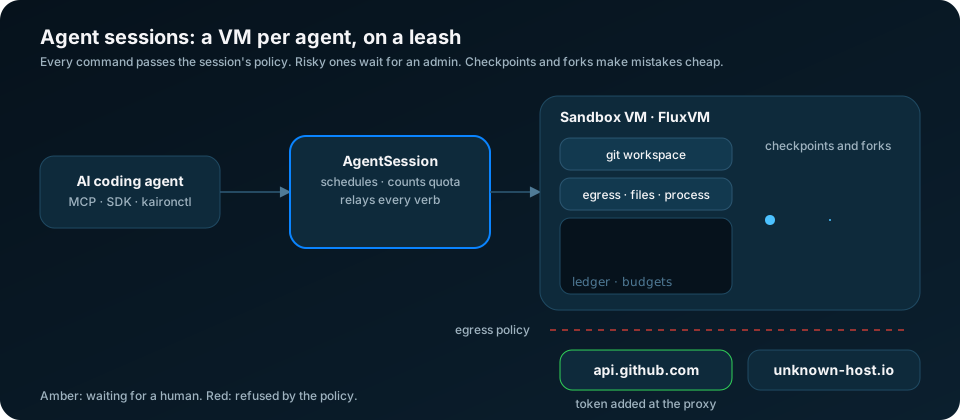
The biggest Kairon release yet: sandboxes for AI coding agents, failover to a second cluster, GPUs and Macs as schedulable pools, and every virtctl verb in kaironctl. New features are opt-in and marked Experimental until their lab rows pass.
Also in v0.10.0
- DRS on measured pressure (PSI), and node maintenance mode that migrates, hibernates or parks Machines.
- NVMe-oF volumes with native multipath, raw Block boot, and per-disk IOPS and bandwidth limits changed live.
- Adaptive live migration: auto-converge, then post-copy, inside a downtime and completion budget.
- Incremental S3 backups, topology-aware placement, elastic memory, virtual networks and hibernate.
- Incident bundles: one redacted tar.gz with cluster state and the node’s QMP, cgroup, console and pcap.
- kaironctl selftest, a live dashboard over server-sent events, and HTTPS everywhere by default.
Upgrading from v0.9
The dashboard now serves HTTPS and the console relay uses TLS, so upgrade kairon-ui and kairon-node together. Apply the CRDs and RBAC from the v0.10.0 tag before the new binaries: eleven CRDs are new. FluxVM 0.4.8 has every route this release uses.
See it move
How it works, in motion.
Each diagram loops through one feature from start to finish. Pick one; the guide has the details and the real limits.
Measured, not marketed
Half the stack. Same VM.
Same k3s node, same Ubuntu 24.04 guest, same 1 vCPU and 512 MiB, one script driving both. What you stop paying for is everything KubeVirt puts around the VM.
less idle control plane
63 MiB against 905 MiB of memory.
faster to SSH, five VMs
24.8 s against 184.7 s, median.
pods per running VM
The VM is the only thing running.
hypervisors, one CRD
QEMU, Cloud Hypervisor, Firecracker, FluxVM.
KubeVirt v1.9.0. Method, raw JSON and caveats: read the benchmark
Verified on real hardware · 15 October 2026
Live migration, run and recorded.
Two real hosts, both directions, encrypted, with source-failure, controller-failover and NeedsRecovery drills, plus a container sandbox on a Mac. One run per case on an idle guest; the page lists what was not run.
cases run
Eight passed, none failed.
worst live downtime
Six live migrations, 64 ms at best.
of 6 encrypted
Data plane TLS on a fresh CA.
Architecture
Two Go binaries and your KVM hosts.
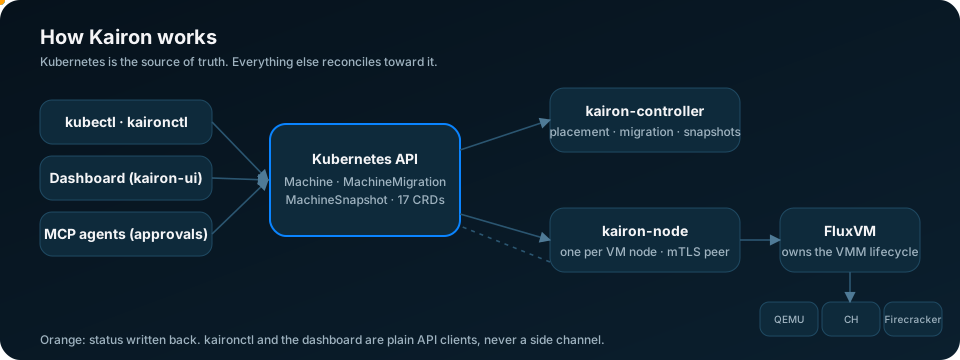
Kubernetes is the source of truth. kairon-controller places a Machine; kairon-node on the host turns it into FluxVM calls. Both are Go standard library only, small enough to read in an afternoon.
Everything a VM platform needs
Run. Move. Protect. Automate.
One Machine resource covers the lifecycle. Features marked Experimental are opt-in; what has run in the lab, and what has not, is written down.
Easy deployment
From a bare host to a booted VM in one command.
--remote-build compiles on the host, so your laptop needs no Go and no Node. Everything is HTTPS by default. The self-test boots a tiny CirrOS VM to prove it all works.
Label a node
kubectl label node worker-1 kairon.zyvor.dev/capable=true
Deploy
deploy-remote.sh user@host --remote-build --with-ui, or one Helm command from GHCR.
Prove it
kaironctl selftest boots CirrOS and checks power, network, hotplug and snapshots.
Open the dashboard
HTTPS out of the box, with a Self-test page and live updates.
Dashboard
Watch it live. Fix it fast.
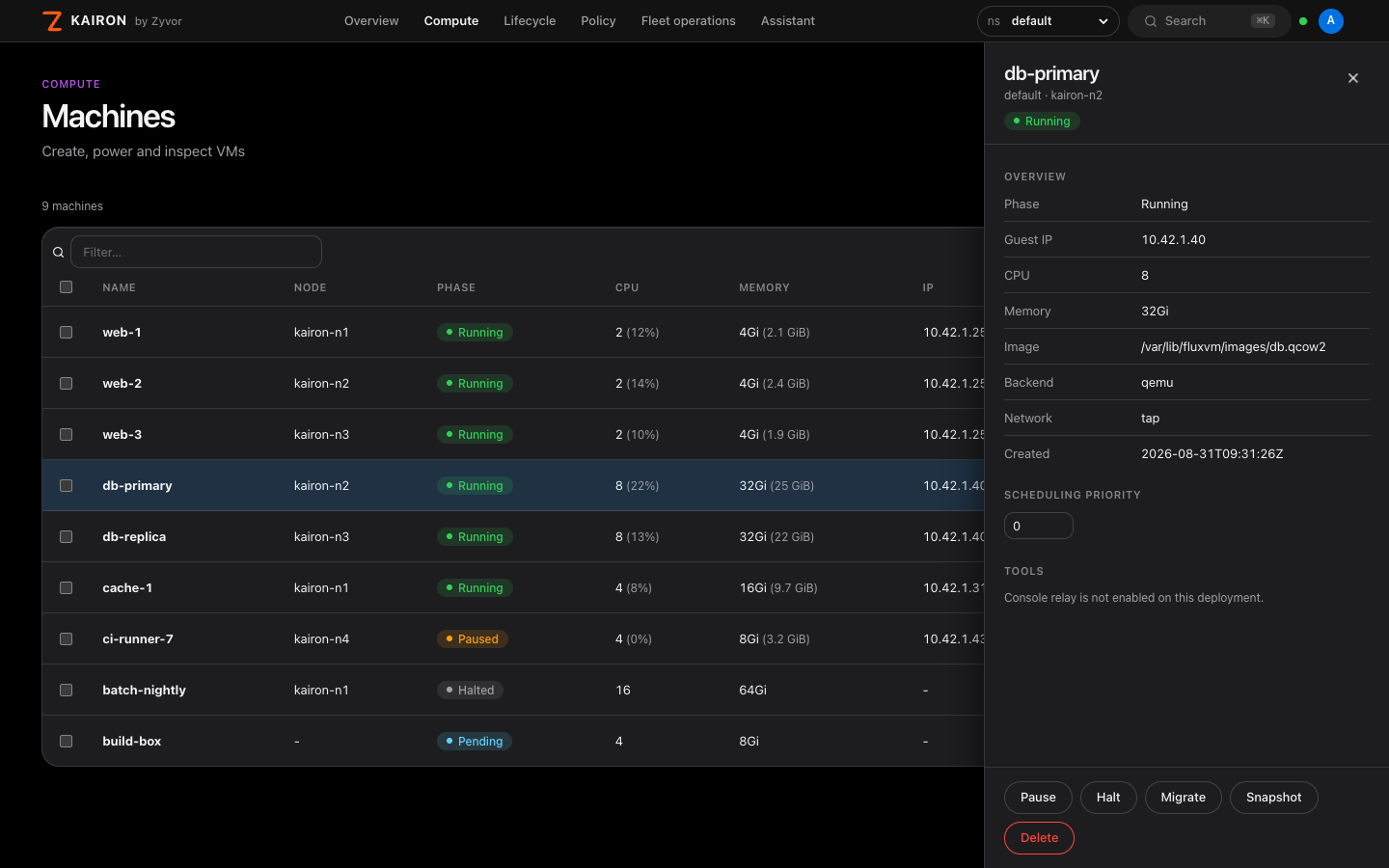
Machines stream over SSE with a per-VM timeline and metrics, fork and hotplug actions, a node capacity what-if, Topology, System and Network pages, a Self-test page, and an Agent sessions page with approvals and the Mac guest’s screen. It is just another Kubernetes API client.
Who it is for
One platform, many shapes.
Honest status
What is verified, and what is not.
Production gaps stay listed, not glossed over.
Verified Lab
- Boot, power, network, vCPU hotplug and snapshot-restore on a real FluxVM host (kaironctl selftest).
- Cold and live migration between two real hosts over mTLS, including adaptive auto-converge, post-copy switch and zstd, and the source-failure, NeedsRecovery and controller-failover drills (lab run of 2026-10-14). Re-run on 2026-10-15 on a re-keyed pair: cold, live in both directions, and the three failure drills all passed (idle guest, one run each).
- A container image run as a FluxVM sandbox on a real Mac, created and read back through Kairon’s client.
- Node maintenance draining Machines to another node by live migration.
- Snapshots and DRA bridging.
- Native macOS node on an Apple M4 with a real k3s cluster.
- Single-node lab runs of hibernate, elastic memory, virtual networks, NVMe-oF, disk QoS, vGPU, accelerator profiles, node maintenance, DRS, incident bundles and agent sandboxes.
- Cross-cluster DR replication, failover, failback and DR tests, with both sites on one lab node.
- Controller and node are Go standard library only (enforced in CI).
Not yet
- The NeedsRecovery drill passed 5 of 6 runs on 2026-10-14 and failed once unexplained, then passed on the 2026-10-15 re-run; live migration with the eBPF dataplane has not run, and none of it runs in this repo’s CI yet.
- Container sandboxes through kairon-node and the controller on a Mac have not run; only the FluxVM call path has.
- Plain pre-copy under a heavy write load did not converge on a 1 Gbps link; adaptive migration is the answer.
- Incremental S3 backups, hibernate resume on another node and cross-host virtual networks are not verified.
- Agent sessions have not run on a real Mac yet.
- Mac Fabric has only run against simulated Mac nodes; multi-Mac clusters are not verified.
- DR between two real clusters, and anything needing an NVIDIA GPU or a BGP router.
- Experimental features are labelled; read their “Real limits today”.
Run your first VM today.
Apache-2.0, free to run in production. Zyvor Enterprise adds support and SLAs.