Agent sandboxes
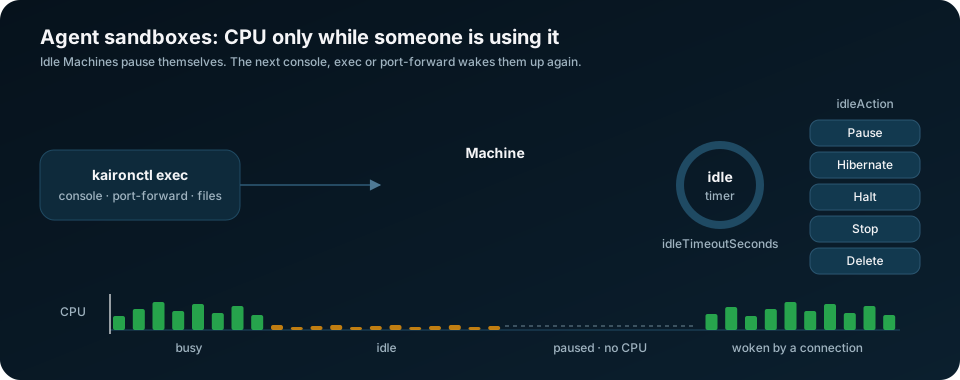
An agent sandbox is a Machine an AI agent or a developer uses for a while
and then forgets about. Kairon can run thousands of them cheaply when they
suspend themselves when idle, wake up when someone connects, delete
themselves after a deadline, start from a pool of paused VMs, and report
what each claim used. All of it is opt-in and experimental; a Machine
without spec.lifecycle behaves exactly as before.
Lifecycle
apiVersion: kairon.zyvor.dev/v1
kind: Machine
metadata:
  name: agent-42
  labels: {kairon.zyvor.dev/sandbox: "true"}
spec:
  image: {path: /var/lib/fluxvm/images/kairon-hw.qcow2}
  resources: {cpu: "2", memory: 2Gi}
  guestAgent: {enabled: true}
  lifecycle:
    idleTimeoutSeconds: 600     # min 60
    idleAction: Pause           # Pause (default), Hibernate, Halt, Stop or Delete
    idleCPUMillicores: 50       # below this guest CPU use counts as idle (default 50)
    maxLifetimeSeconds: 86400   # delete the Machine after a day
    wakeOnConnect: true
    wakeTimeoutSeconds: 60      # default 60
The same from the CLI:
kaironctl create agent-42 --image /var/lib/fluxvm/images/kairon-hw.qcow2 \
  --idle-timeout 10m --idle-action Pause --max-lifetime 24h --wake-on-connect
kaironctl describe machine agent-42   # Lifecycle: idle 3m12s of 10m0s, expires in 23h…
What counts as activity.
- Guest activity. kairon-node samples each lifecycle Machine every reconcile tick: CPU time of the VMM process from
/proc, and FluxVM's disk byte counters. Guest CPU aboveidleCPUMillicores, or disk I/O above 256 KiB/s, is activity, and so is a new VMM process. kairon-node writesstatus.lifecycle.lastActivityTimeat most every 30 seconds. - Relay sessions. kairon-ui stamps
kairon.zyvor.dev/last-activitywhile a relay session uses the Machine: console, VNC, SSH or port-forward, exec, file transfer or the sandbox HTTP proxy. An open session keeps the Machine active even when the guest is quiet.
Idle action.
- kairon-controller compares the later of the two activity times with
idleTimeoutSeconds. It acts only on a Running Machine that is not migrating and whosespec.powerStateis unset orRunning. - Every action except Delete sets
spec.powerStateandkairon.zyvor.dev/idle-suspended; Delete removes the Machine. - Each action records an
IdleSuspendedEvent and counts inkairon_lifecycle_actions_total{action}. - Disruption budgets do not block lifecycle actions, because the Machine opted in.
Max lifetime.
- The lifetime counts from creation, or for a claimed pool member from
kairon.zyvor.dev/lifecycle-start, which the controller sets when the claim binds. - When it ends, the controller deletes the Machine and records a
LifetimeExpiredEvent. - Warm pool members are exempt until they are claimed.
Wake on connect.
- With
wakeOnConnect: true, the routes listed above (console, VNC, SSH and port-forward, exec, files, sandbox proxy) first resume a Machine the controller idle-suspended. - To resume it, kairon-ui sets
spec.powerState: Running, clearsidle-suspendedand waits up towakeTimeoutSecondsfor the Machine to run. After a wake from anything other than Paused, it also waits for the guest agent. - A timeout returns HTTP 504.
- A Machine you paused yourself stays paused, and
kaironctl startclears the annotation. - Resume time depends on the action:
- Pause: milliseconds.
- Hibernate: about the time it takes to restore memory.
- Halt: a boot.
- Stop: a boot from the image, losing the disk unless it is on
spec.volumes.
Paused warm pools
A MachinePool normally keeps its warm members Running. With
warmPowerState: Paused each member boots, runs for warmupSeconds
(default 30) so the guest finishes starting, and is then paused: it keeps
its memory but uses no CPU. Binding a MachineClaim resumes it in
milliseconds and stamps its lifecycle start.
kaironctl create machinepool agents --image /var/lib/fluxvm/images/kairon-hw.qcow2 \
  --replicas 20 --warm-power-state Paused --warmup 45s
kaironctl get machinepools          # WARM-STATE column
kaironctl claim agents --ttl 1h
A Running pool resumes members that are Paused, unless its template itself asks for Paused. Surplus trimming removes members that are not warm first.
Claim usage
A bound MachineClaim accrues status.usage from its Machine every 30
seconds: activeSeconds (Running), suspendedSeconds (Stopped, Paused,
Hibernated or Halted), vcpuSeconds and memoryGiBSeconds (active time
only). Other phases advance the clock without accruing.
kaironctl get machineclaims          # ACTIVE, SUSPENDED and VCPU-S columns
kaironctl describe machineclaim job-42
The same totals feed kairon_claim_usage_seconds_total{namespace,state},
kairon_claim_usage_vcpu_seconds_total and
kairon_claim_usage_memory_gib_seconds_total. When a claim is deleted the
controller records a Released Event with the final usage. The MCP
describe_claim tool returns it too.
Letting operators drive sandboxes
Guest exec and file transfer are admin-only. Setting the Helm value
ui.auth.sandboxOperatorExec: true (KAIRON_UI_SANDBOX_OPERATOR_EXEC=true)
lets a named non-admin operator use exec, files and the sandbox HTTP proxy
on Machines labelled kairon.zyvor.dev/sandbox=true in namespaces they
can already use. The legacy shared token has no identity and stays
refused. Every other Machine keeps the admin-only rule.
SDKs
The Python and TypeScript SDKs wrap all of this in a Sandbox class:
from kairon import Client, UIClient, Sandbox

kube = Client(KUBE_URL, KUBE_TOKEN, namespace="agents")
ui = UIClient(UI_URL, UI_TOKEN, namespace="agents")
with Sandbox.create(kube, ui, image="/var/lib/fluxvm/images/kairon-hw.qcow2",
                    idle_timeout=600, max_lifetime=3600) as sb:
    print(sb.run("uname -a", check=True).stdout)
    sb.write_file("/tmp/task.py", b"print('hi')")
    proc = sb.start("python3 /tmp/task.py")
    proc.wait()
    print(proc.logs())
    child = sb.fork()          # live copy of the sandbox
    child.close()
Sandbox.claim_from(kube, ui, "agents") takes a warm pool member instead,
and close() releases the claim. pause(), resume() and fork() map to
the matching power and fork operations. The TypeScript SDK uses the same
names in camelCase (claimFrom, readFile, writeFile). A runnable
example is sdk/python/examples/agent_sandbox.py.
Related commands
kaironctl start MACHINE --pausedcreates a Machine straight into Paused. kairon-node boots it and pauses it at once, so the guest runs briefly first; it is not QEMU's-S.--dry-runon start, stop, halt, pause, resume, restart and migrate sends the change withdryRun=Alland prints the result without storing it.kaironctl freeze MACHINE [--unfreeze-timeout 5m]andunfreezefreeze the guest's filesystems through qemu-guest-agent. They writekairon.zyvor.dev/fs-frozen-until; kairon-node freezes, confirms withkairon.zyvor.dev/fs-frozen, and thaws on its own at the deadline.kaironctl forkandkaironctl create clonebranch a sandbox; see Forking a running Machine.
Limits
- Idle detection is as fine as kairon-node's reconcile tick plus the 30 s activity write interval, so an idle action can come up to a minute late.
- Activity inside the guest that uses neither CPU nor disk (a process blocked on the network) does not count; use a relay session or a longer timeout.
- Hibernate and Halt need the qemu backend's support for them on the node; see Hibernate and Halt.
- Lab results for each step are in
COMPATIBILITY.md.