Kairon on Macs: every Mac a Node, from a Mac mini to a Mac Studio cluster
Kairon's controller and node agent run natively on Apple silicon, and kairon-node registers a Mac as a Kubernetes Node
(see macos.md). That turns a shelf of Macs into one scheduling pool: Kairon places Machines by unified memory,
FluxVM runs them on Virtualization.framework, and
Velora serves private, OpenAI-compatible LLM endpoints on the same Macs.
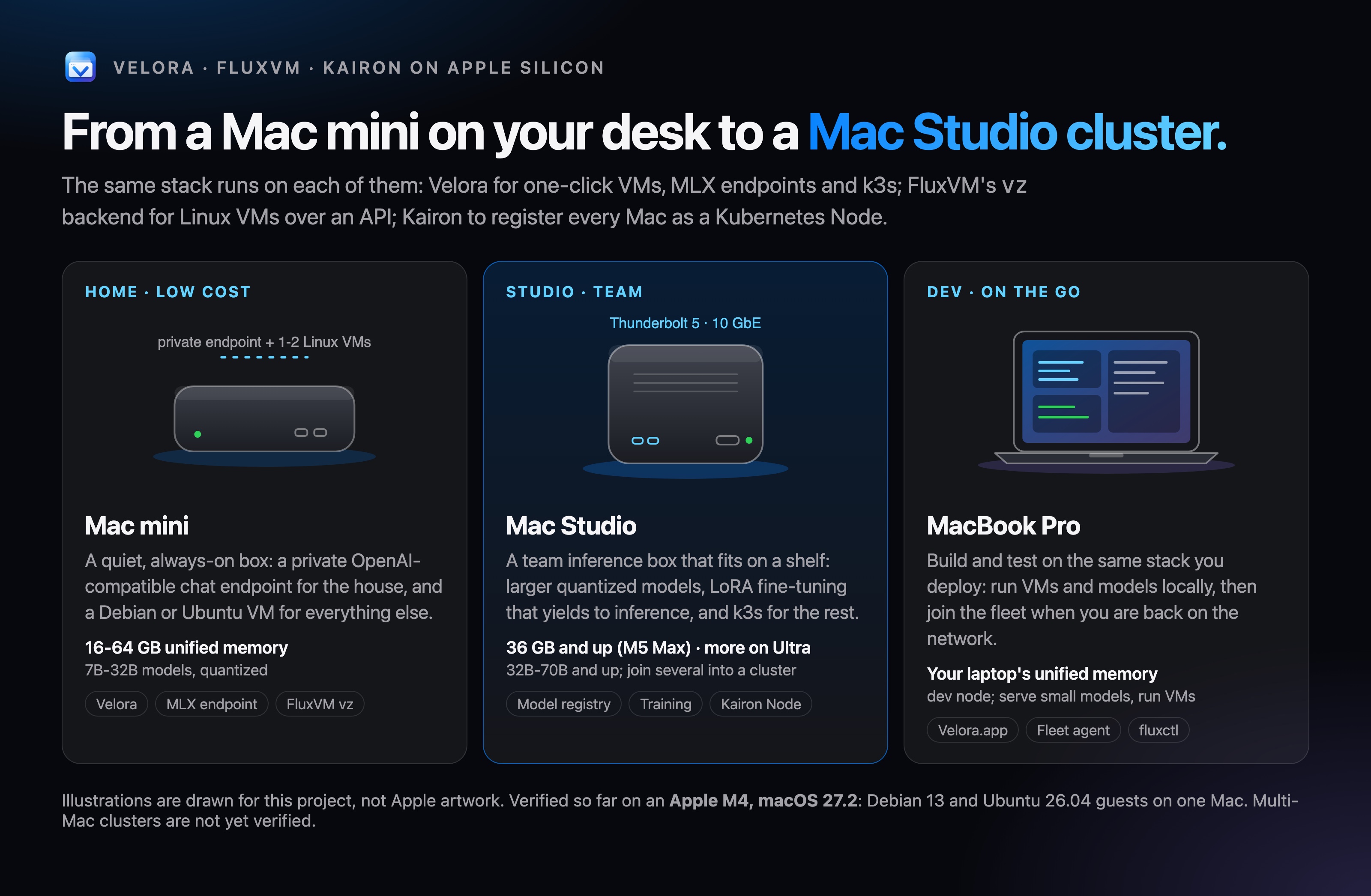
Why Macs
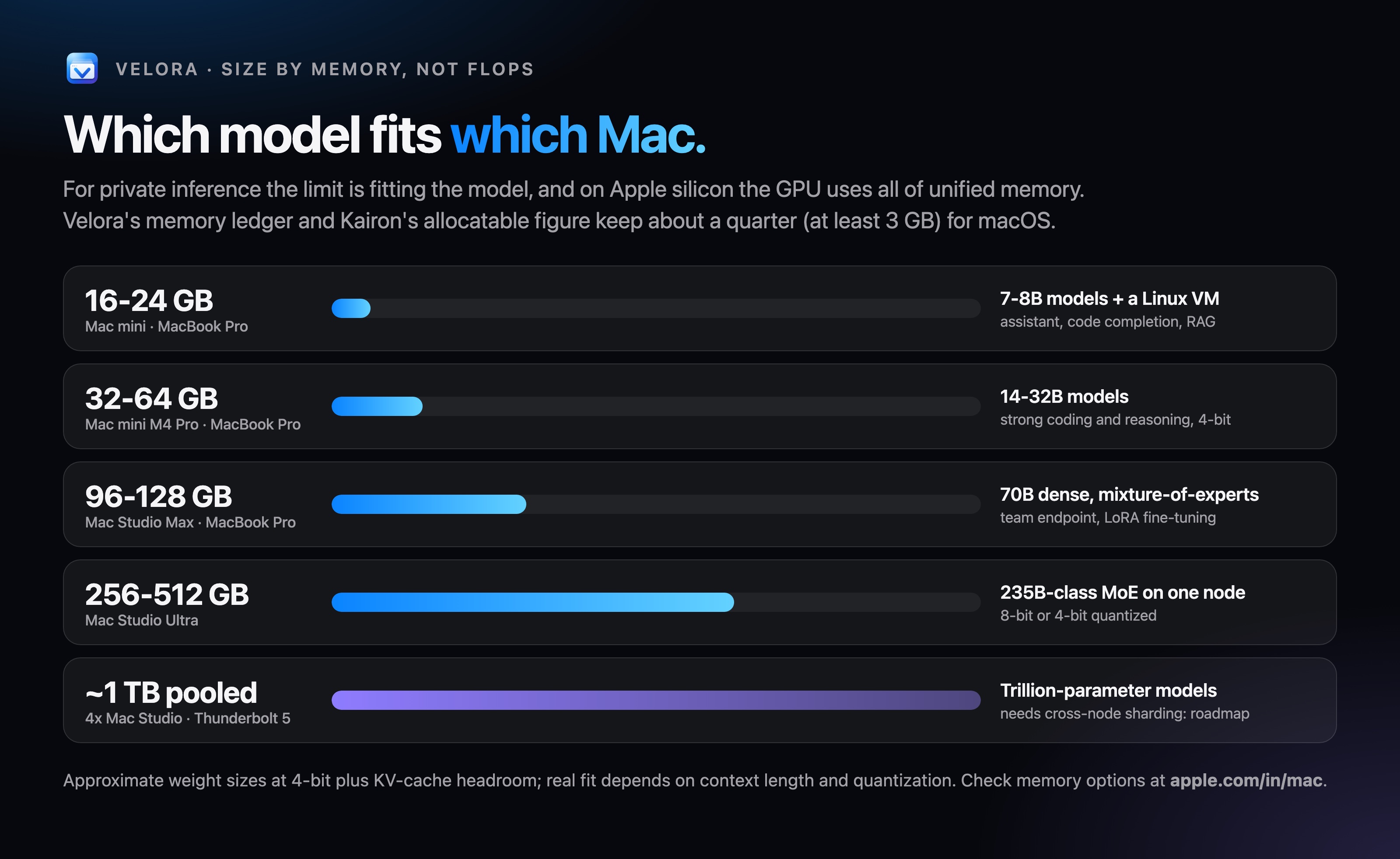
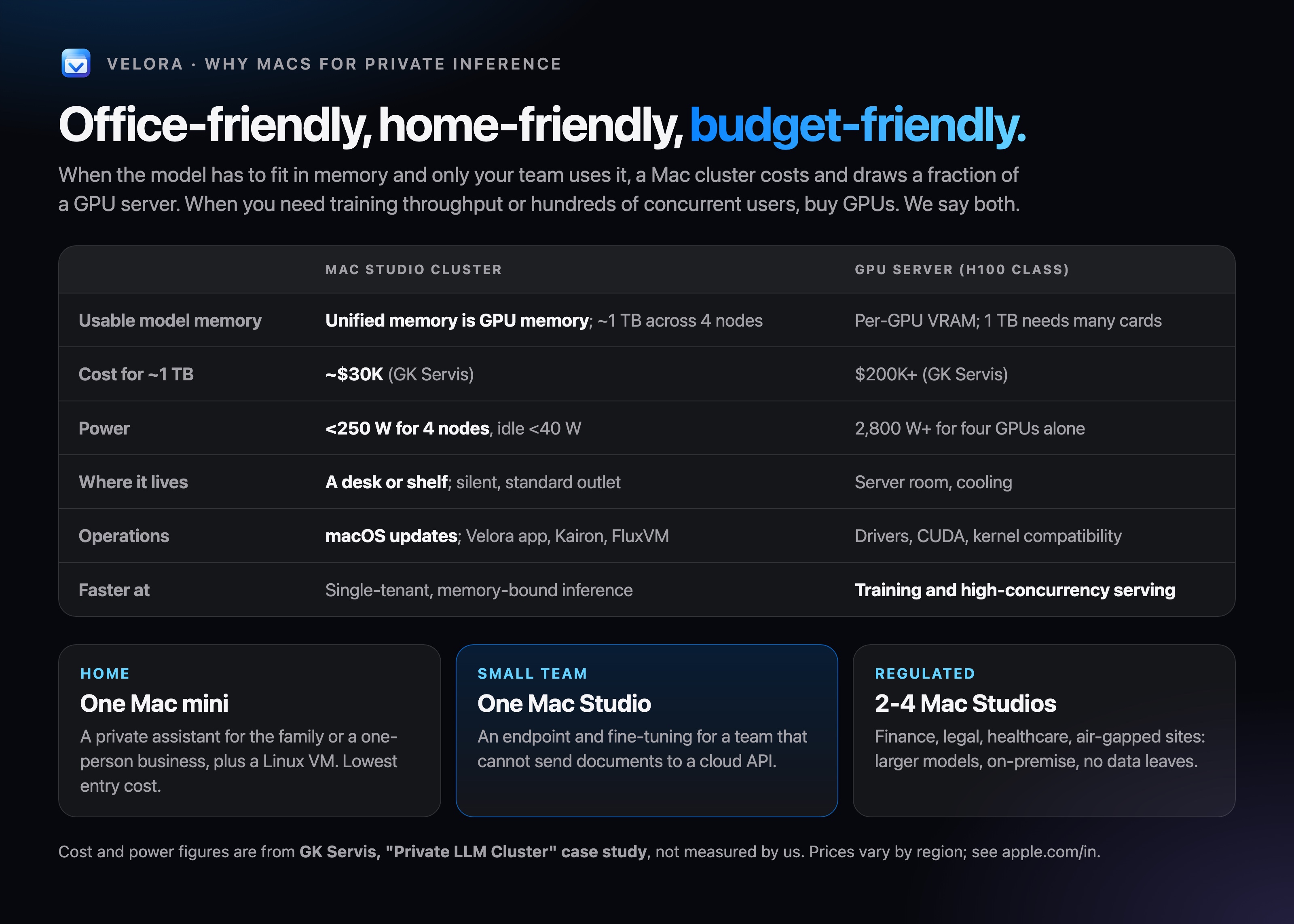
For single-tenant private inference the limit is memory, not FLOPS, and on Apple silicon the GPU uses all of unified memory. A Mac Studio is a large-memory accelerator that sits on a desk, runs silently from a standard outlet and needs no CUDA stack. NVIDIA remains faster for training and high-concurrency serving; this page is about the other case.
| Tier | Hardware | Kairon's role |
|---|---|---|
| Home, low cost | Mac mini | One Node, a VM or two beside a private chat endpoint |
| Developer | MacBook Pro | A Node that comes and goes; Machines reschedule when it leaves |
| Team | Mac Studio (M5 Max, 36 GB and up) | A Node labelled kairon.zyvor.dev/mlx=true with an inference-url |
| On-premise cluster | 2-4 Mac Studios | One pool; Machines placed by allocatable unified memory |
How the cluster fits together
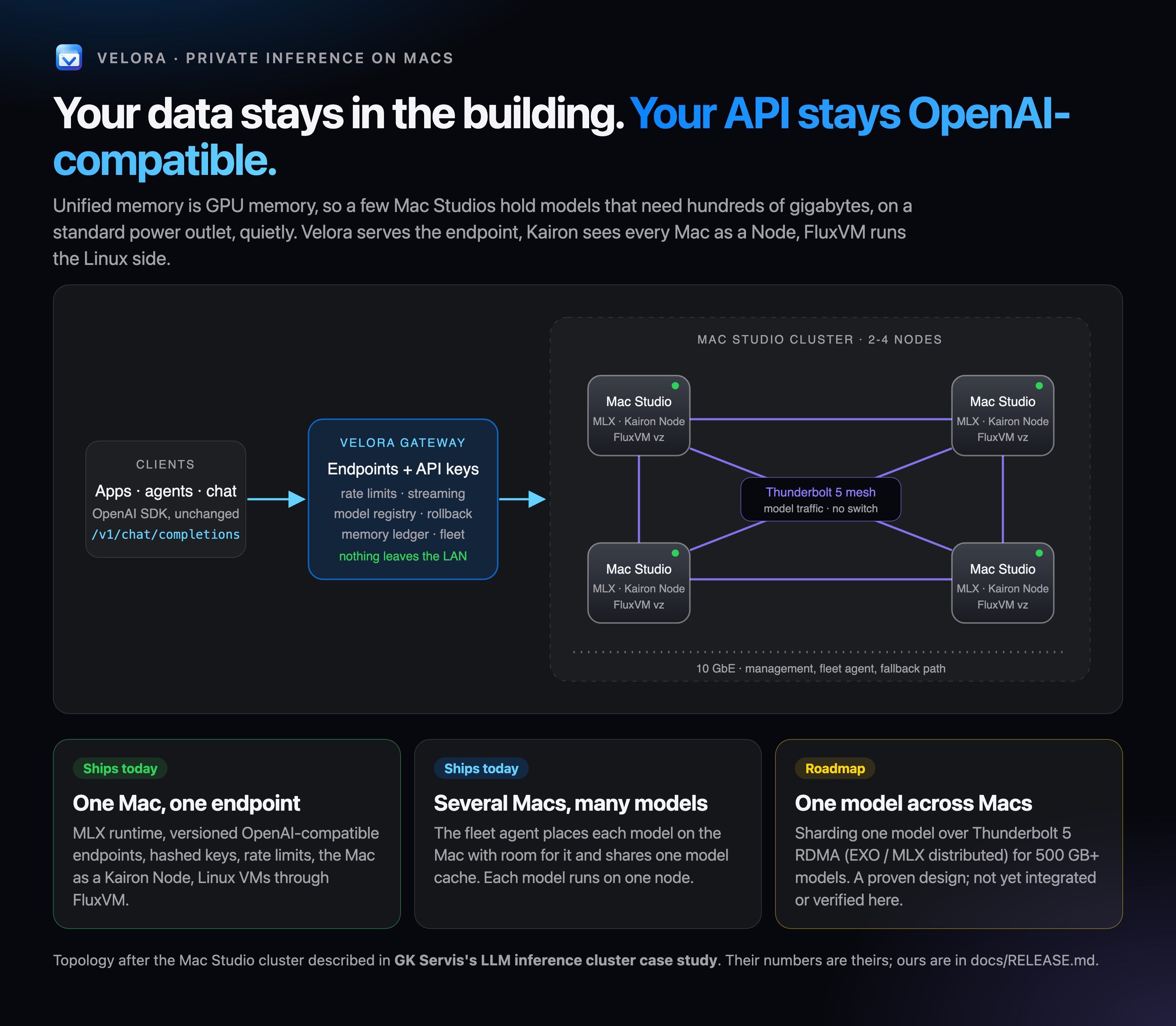
- Kubernetes API. Any cluster; Velora can host a single-node k3s in a VM on one of the Macs.
- Each Mac runs
fluxctl serve(FluxVM,vzbackend),kairon-nodewithNODE_NAMEset, and optionally Velora's MLX runtime (pass--mlx-urlso the Node getskairon.zyvor.dev/mlx=trueand aninference-urlannotation). - Allocatable memory on each Mac Node is unified memory minus the larger of 3 GiB and a quarter, left to macOS and the models.
- Machines with
runtime.backend: vzgo only to Macs and tolerate thekairon.zyvor.dev/vm-only:NoScheduletaint automatically. Addkairon.zyvor.dev/mlx=trueto land next to the models,kubernetes.io/hostnameto pin to one Mac, orspec.appleto ask for a chip generation, macOS version, Rosetta or nested virtualization (Mac Fabric). - Private networks across Macs. A
MacNetworkgives Machines on different Macs one private Layer-2 network, over the Thunderbolt Bridge when the Macs are cabled together and started with--thunderbolt-fabric(Mac Fabric).
kubectl apply -f deploy/crd.yaml -f deploy/rbac.yaml -f deploy/macos/rbac.yaml
kubectl apply -f examples/macos-fleet.yaml      # a gateway VM beside the models, a CI runner on the Mac mini
kubectl get machines -o wide                     # Node and status.guestIP per Machine
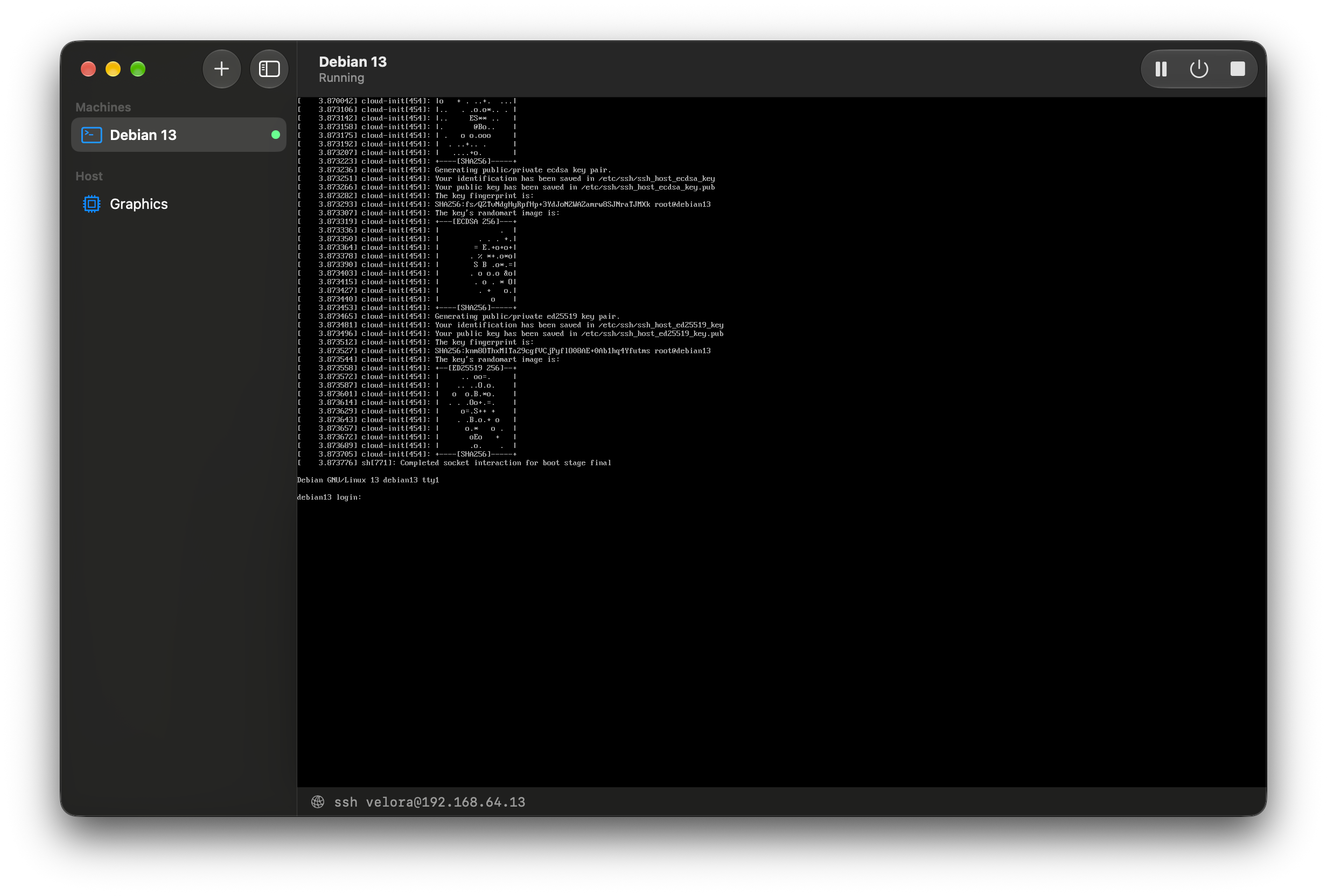
A real capture on an Apple M4, macOS 27: a Debian 13 guest on Virtualization.framework, shown in Velora's app.
- Network: 10 GbE for the Kubernetes API, the fleet and VM traffic. A Thunderbolt mesh can carry
MacNetworktraffic between the Macs' guests (FluxVM's encrypted UDP overlay, not RDMA). Model traffic for a model sharded across Macs is the inference stack's own and does not go through Kairon. - Reference design: GK Servis's Mac Studio LLM inference cluster (4x Mac Studio, Thunderbolt 5 RDMA, EXO + MLX, about 1 TB pooled, under 250 W). Their figures are theirs, not Kairon measurements.
Verified and not verified
- Verified on an Apple M4, macOS 27.2 (Go 1.27.1): build, vet and all test packages on darwin;
scripts/macos-e2e.shagainst a k3s cluster hosted in Velora (Node Ready, avzMachine scheduled and Running through FluxVM,status.guestIP, SSH, delete). - Run against simulated Macs: capability labels,
spec.applescheduling,MacNetworkallocation and the overlay files kairon-node writes (scripts/lab-mac-fabric.shon a Linux cluster; COMPATIBILITY.md). - Not verified: more than one Mac Node,
examples/macos-fleet.yamlon real hardware, aMacNetworkcarrying traffic between Macs, Rosetta or nested virtualization in a guest, macOS guests, migration, CSI, the VNC console relay, Thunderbolt RDMA. - Roadmap for the stack: per-node temperature and tok/s in kairon-ui, and model-aware placement that reads Velora's
memory ledger. Thunderbolt-linked Macs are labelled
kairon.zyvor.dev/thunderbolt-fabric.
The hardware drawings are original illustrations for this project, not Apple artwork. Mac, Mac mini, Mac Studio and MacBook Pro are trademarks of Apple Inc.