Fleet, HA and DRS
Add hypervisors by installing machina-agent on each one. The controller then treats them as one pool.
./scripts/deploy-remote.sh USER@HOST --platform --platform-bind 0.0.0.0
What the controller does
- Inventory and desired state. The controller records what should be running where and reconciles drift.
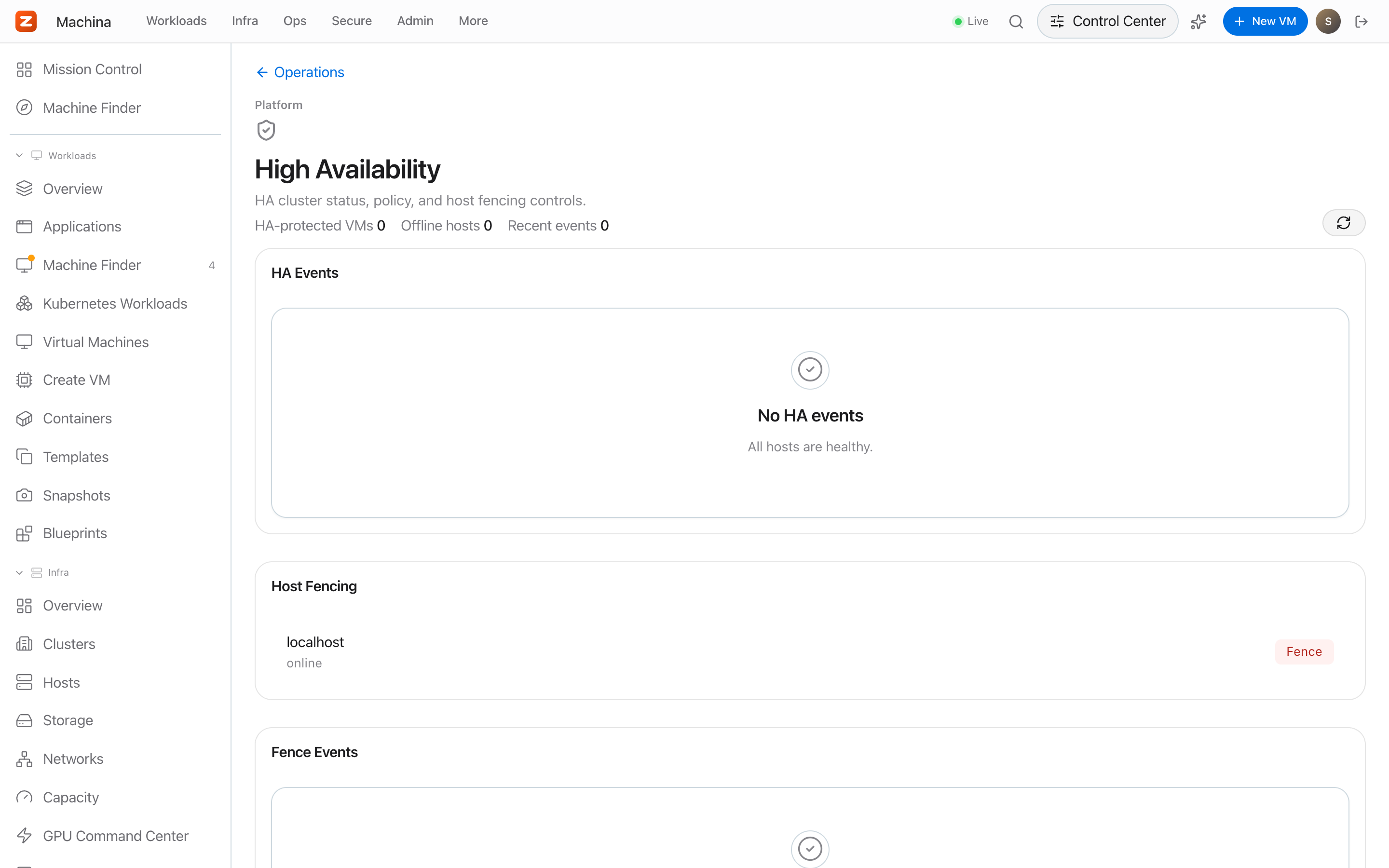
- HA failover. When a host stops responding, its protected VMs are restarted on healthy hosts, with host fencing to avoid split-brain.
- DRS. Distributed resource scheduling rebalances load across hosts by live-migrating VMs.
- Live migration. Move running VMs between hosts from the UI or API.
- Placement. New VMs land on a host chosen by capacity and policy.
- Fleet-wide eBPF. Policies, shield, isolation and telemetry fan out to every host's
machina-bpfdthrough its agent.
How failover, fencing, DRS and multi-controller leader election work in detail: Controller HA.
Daemon-only fleets
Without the controller, machina-daemon can still aggregate peer daemons for a merged inventory:
[fleet]
enabled = true
primary_peer = "hv-east"
standby_peer = "hv-west"

[[fleet.peers]]
name = "hv-east"
url = "https://hv-east.example.com:5092"
api_token = "mach_…"
| Endpoint | Purpose |
|---|---|
GET /api/v1/fleet/status | Peer health and versions |
GET /api/v1/fleet/vms | Merged VM list (local and peers) |
POST /api/v1/fleet/peers/{name}/proxy | Forward an API call to a peer |
This mode is for inventory and active/standby operation; automatic failover comes from the controller.