How it works
From a question to an approved, recorded action.
Ground
Hybrid retrieval finds the passages behind the answer, filtered by who may see them.
Act
Agents and workflows call your APIs and MCP tools within a bounded budget.
Approve
Anything that writes, sends or spends pauses until a second person signs off.
Prove
Runs, guardrail decisions and approvals land in a hash-chained audit log.
Capabilities
Everything an AI platform needs.
Nothing that leaves your network.
Your models, your endpoints
Connect any model you run, on an exact host allow-list. Cascade routers start small and escalate when a judge flags a weak answer, with cached tokens priced in.
Author is never approver
Consequential steps wait for a different person, who sees the exact action and its fingerprint.
Guardrails as policy
Word and regex filters, PII with checksum validation, contextual grounding and an optional classifier model.
Knowledge with access rules
Web, S3 and Confluence connectors sync incrementally. Group rules from SSO decide who retrieves what.
Agents with real tools
Import OpenAPI actions, attach MCP servers, keep long-term memory, and trace every step in a waterfall.
Documents, images, audio
OCR, transcription and vision in chat. Extraction blueprints turn documents into fields, with low-confidence review.
Evaluate and experiment
Grounded and LLM-judge evaluations, plus prompt experiments that compare variants on the same suite.
Fine-tune and distill
Validated datasets go to your own trainer for LoRA, QLoRA or distillation, and the result registers as a model.
Image generation
An images API and playground mode, with budgets, guardrails and expiring artifacts.
Evidence and cost
A usage ledger with budgets per workspace beside an audit chain you can export and verify offline.
The console
A real product, not a mockup.
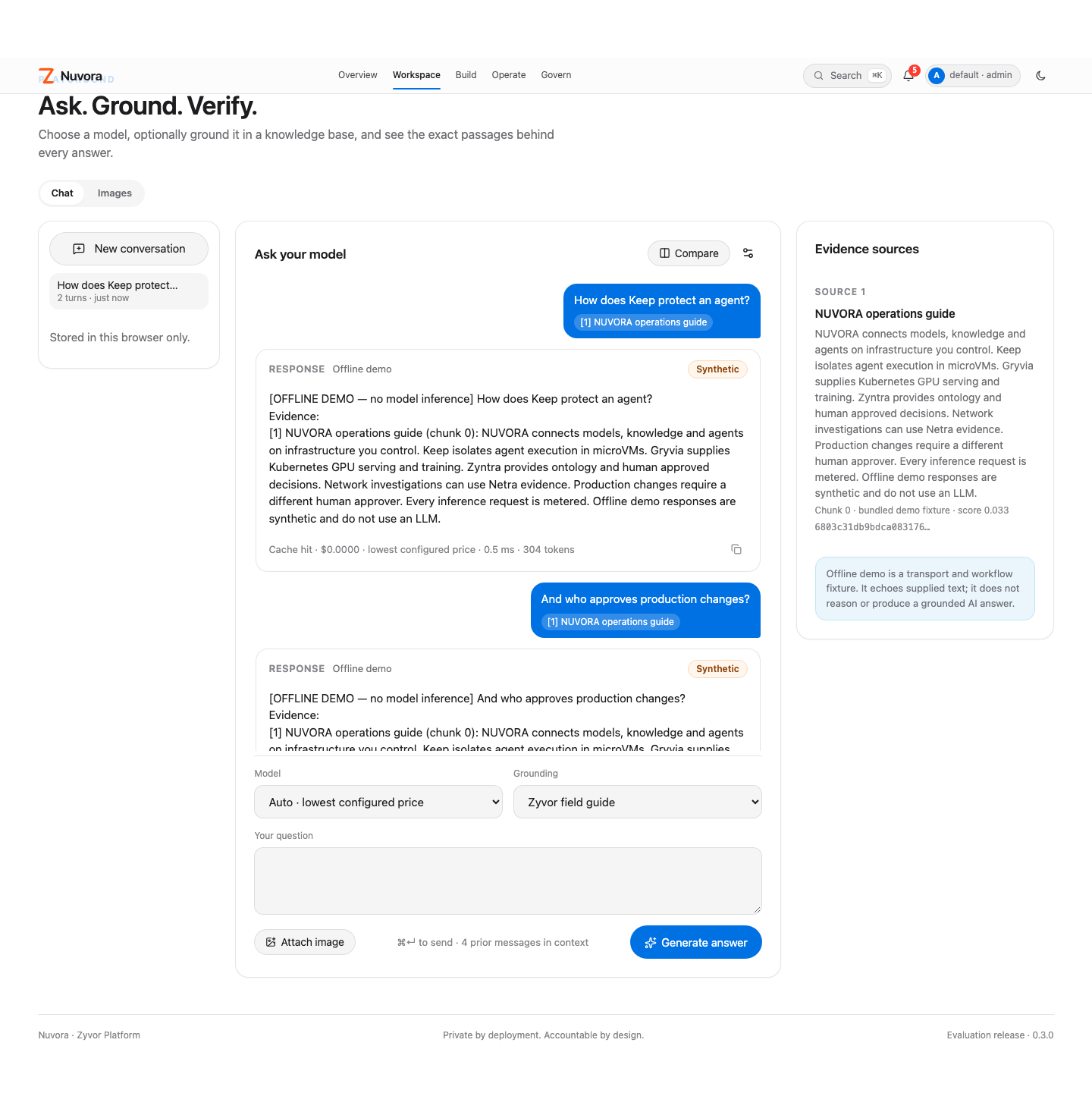
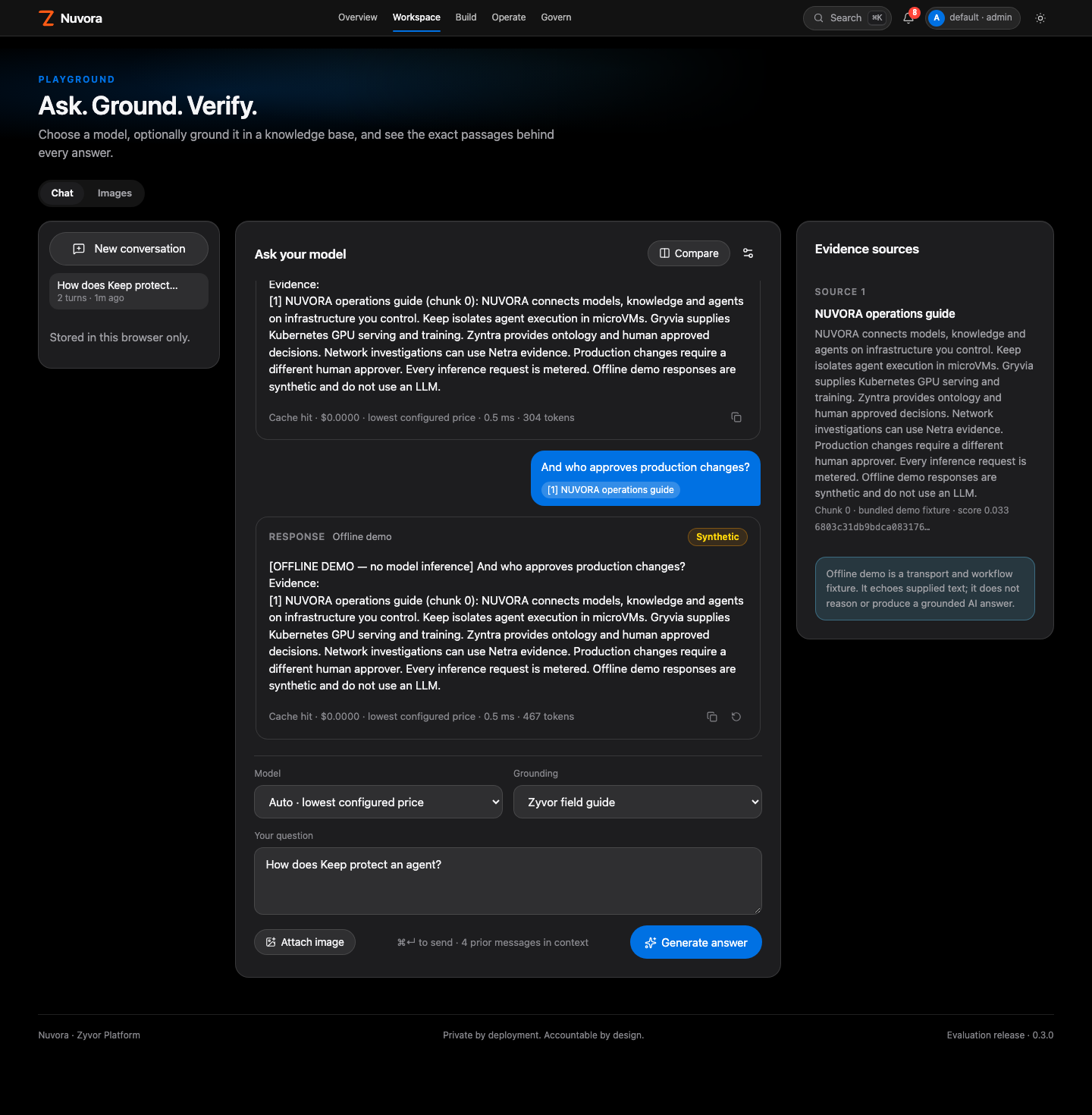
Ask, ground and verify: every answer next to its sources. See all views →
Drop-in API
Point your existing clients at Nuvora.
Chat, streaming and image endpoints speak the OpenAI wire format, so SDKs and tools work unchanged. Behind them, every request passes guardrails, routing, budgets and the audit chain.
- Scoped service tokens per workspace
- Token budgets and concurrency caps
- Every call metered and recorded
import os
from openai import OpenAI

client = OpenAI(
    base_url="https://nuvora.example.com/v1",
    api_key=os.environ["NUVORA_TOKEN"],  # a scoped service token
)

reply = client.chat.completions.create(
    model="auto",  # or a model id, or "router:<id>"
    messages=[{"role": "user", "content": "Summarize our refund policy"}],
)
print(reply.choices[0].message.content)
Why Nuvora
Built for the questions risk teams ask.
You can’t send prompts or documents to a hosted AI vendor
Your own endpoints only, on an exact host allow-list
Answers sound right, but nobody can say where they came from
Cited passages with content digests on every grounded answer
An agent wants to send, write or spend
The step pauses until a different person approves the exact action
Audit asks what happened six weeks ago
A hash-chained audit log you can export and verify offline
Teams share a platform but not their data
Tenant-scoped storage, four roles, SSO groups and document access rules
Finance asks what AI costs
A usage ledger per workspace, with budgets and cache savings
Run it on your laptop in a minute.
Run it on your cluster in one command.
./scripts/deploy-remote.sh HOST USERBuilds on the host, imports into k3s and serves HTTPS with a generated admin password. SQLite on one node, PostgreSQL across replicas.
Zyvor Production License v1.0: free for evaluation, development and other non-production use; production needs a commercial license. The capability matrix in the repository says exactly what is and isn’t built.