How it works
A real computer for an agent you can’t fully trust.
A sealed cell, keys you hold, approvals only you can give, and a counter that proves it.
The agent works in its own microVM with its own kernel. It cannot reach your machine, and the network rules live on the host, outside its reach.
Enforced by the host
- Gateway reachable
- QUIC and WebRTC
- Cloud metadata
- Public DNS
If a connection slips through anyway, the session freezes.
New
Approvals wherever you already are.
Your team’s chat, your observability stack, every cluster in one place, and your Android phone.
- Approve from Slack or TeamsEach request arrives with the host-rendered preview and its digest. Buttons appear only when no phone signature is required; otherwise it is a link to your phone.
- Watch it in your own toolsSend the audit trail to any OpenTelemetry collector over OTLP/HTTP. An allowlist keeps file contents, previews and credentials out.
- One view, every clusterRegister peer Fabric daemons and see hosts, VMs and health together. A host that is down never breaks the list.
- Approve from AndroidA native app signs with a hardware-backed key behind your fingerprint. Same signature format as iPhone.
Tested against local fakes, not a live Slack workspace, collector, second daemon or Android device. Read the details.
See it
The agent proposes. A person decides.
A real run of the Merion runtime: the agent’s change waits behind an approval, and nothing reaches the sandbox until a person says yes.
./scripts/record-demos.sh merion-speculate.The cockpit
What you watch while it works.
A goal, its plan, the decisions the policy made, and the egress counter — with the honesty badge always on.
/app/merionWhy Merion
You run it. You read it. You take it with you.
You run it
A laptop, a mini-PC or your own FluxVM host. Same API everywhere.
You read it
Policy is a signed merion.policy.yaml you can diff in git. Zyvor Production License v1.0.
You take it with you
merionctl pack writes your policy, agent manifest and migration notes to a folder. merionctl unpack restores them on another FluxVM node. Secrets are not included.
- Bring your own modelA model socket. The cell stays the same.
- Signed policyFail-closed Sentinel loaded from a signed YAML file.
- A real cellFirecracker/KVM microVM on FluxVM with its own kernel.
- Approvals on your phoneBuy, send and delete are approved out of band, never in the chat.
- Auto-approve, only if you set itOff by default. An operator policy can approve a small, in-policy changeset and journal it; anything outside the policy, or needing a phone signature, still waits for a person.
- Cockpit and browser viewSee taint, recent decisions, tabs, screenshots and a read-only screencast.
- One-click use casesPDF brief, contract clauses, security questionnaire, meeting actions, log triage, SBOM summary, CSV cleanup.
- Host network pinFluxVM TC/eBPF: deny_udp and gateway-only ports, enforced outside the guest.
- Pack and unpackPolicy, manifest and migration notes leave as files. Secrets stay in the vault.
Security profiles
Three rungs. One says what it can’t prove.
Merion labels every cell with the evidence it actually has. Measured is software-test; hardware attestation stays gated until a verified run.
- Evidence
- software-test
- Hardware attestation
- Never
- Can the host read it?
- Yes — the host can still see a measured VM
- What you may claim
- A software-test measurement. Never hardware attestation.
profile: "measured"
image_hash: "(soft)"
evidence_class: "software-test"
snp_launch_verified: false
tdx_launch_verified: false
host_recover_allowed: true  // dual keys, audited
operator_can_read: true
Merion states its limit here, in the product. Security profiles ›
Try it
Run it in 60 seconds.
No KVM needed.
git clone https://github.com/zyvorai/fabric && cd fabric
cargo test --manifest-path agent-runtime/Cargo.toml --lib
./scripts/merion-e2e.shFor phone makers
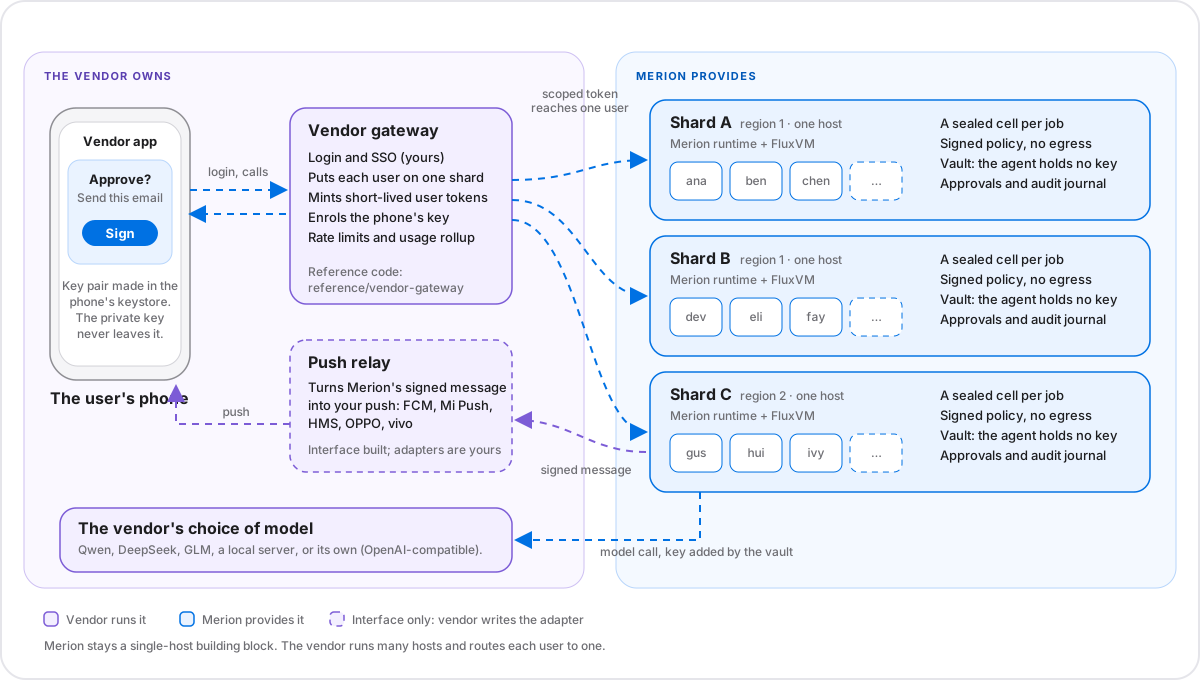
An agent computer per user. The keys stay on the phone.
How an Android maker, or anyone with a phone and an account system, can offer this: a sealed cell per job in your cloud, approvals only the user’s enrolled phone key can sign, and the model you choose.
Mac, Windows, developer and office files
Files from a Mac or a PC, read in a sealed cell.
Ready-made use cases for what people export from their machines and tools (GitHub, Xcode, VS Code, browsers, Excel) and for the paperwork around invoices, purchase orders, staff and claims. Merion reads the file you give it; it does not connect to the computer or drive its desktop, and it is not your books of account.
- macOS · System reportDrop in: system_profiler outputModel, chip, memory, macOS version, protection flags, uptime
- macOS · Homebrew auditDrop in: brew list --versionsPackage count, kept old versions, outdated packages, toolchains
- macOS · Log triageDrop in: log show, compact styleError processes, repeated errors, sandbox denials, kernel trouble
- macOS · Update historyDrop in: softwareupdate --historyWhat was installed, versions, dates, betas
- Windows · System infoDrop in: systeminfo outputOS and build, boot time, memory, domain, hotfix KBs
- Windows · HotfixesDrop in: Get-HotFix as CSVKB numbers, kinds of update, who installed, dates
- Windows · Installed softwareDrop in: An installed-programs CSVTop publishers and programs, first rows
- Windows · Event logDrop in: Get-WinEvent as CSVCounts by level, provider and id; error and warning rows
- Office · Receivables from mailDrop in: A mail exportInvoice numbers, overdue and paid lines, due dates, amounts
- Office · PO line itemsDrop in: A purchase order as textPO number, GSTINs, HSN codes, lines with amounts, open points
- Office · Employee ledgerDrop in: A monthly ledger CSVRows per employee and month, the first rows
- Office · Reimbursement claimsDrop in: A mail exportClaimants, amounts, approved and pending, categories
- Developer · GitHub pull requestsDrop in: gh pr list --jsonStates, authors, labels, merges per month, titles
- Developer · GitHub issuesDrop in: gh issue list --jsonOpen vs closed, authors, labels, issues per month
- Developer · Failed CI logDrop in: gh run view --log-failedError lines, failing steps, exit codes, repeated errors
- Developer · Dependabot alertsDrop in: The alerts JSON from gh apiSeverities, packages, ecosystems, advisories
- Developer · Git log digestDrop in: git log, pipe-separatedCommits per author and month, prefixes, merges
- Developer · Xcode build logDrop in: xcodebuild outputResult, errors by file, repeated messages, failed tests
- Developer · Xcode crash reportDrop in: A legacy .crash reportApp, OS, exception, crashed thread, frames
- Developer · VS Code extensionsDrop in: code --list-extensionsCount, publishers, names
- Developer · VS Code settingsDrop in: settings.jsonSettings set, telemetry and trust lines, secret-looking names
- macOS · Apps inventoryDrop in: system_profiler SPApplicationsDataTypeApps, where each came from, signer, kind
- macOS · Launch itemsDrop in: launchctl listNon-Apple items, exit statuses
- Windows · ServicesDrop in: Get-Service as CSVStatus and start-type counts, names
- Windows · Scheduled tasksDrop in: schtasks /query /fo csv /vTasks, state, last result, run-as account
- Browser · BookmarksDrop in: A bookmarks HTML exportTop sites, folders, titles
- Browser · Browser historyDrop in: Google Takeout BrowserHistory.jsonTop sites, how pages were reached, titles
- Excel · Excel sheetsDrop in: A sales register, stock or attendance sheetRows per customer, location or employee; the first rows
Extractive: no model reads the file, and the office packs list and count rather than add up. The Windows samples follow the commands’ documented layouts and are not yet checked against a real Windows export. The output can name hosts, accounts and software, and the evidence class is software-test. Details and commands.
Honesty
What we don’t claim yet.
- Merion runs on measured VMs today, and its evidence class is software-test. Until it runs on verified confidential hardware with a key only you hold, the host can still see inside the VM, and we will not claim otherwise.